OBJ-01 / Lead time
How fast is the first unit?
A simple 2-layer prototype runs in 3-5 working days and a complex build in 5-10. Volume production commits 3-6 weeks after material release, gated by component availability rather than line time.

Capability envelope / Bayan Lepas, Penang
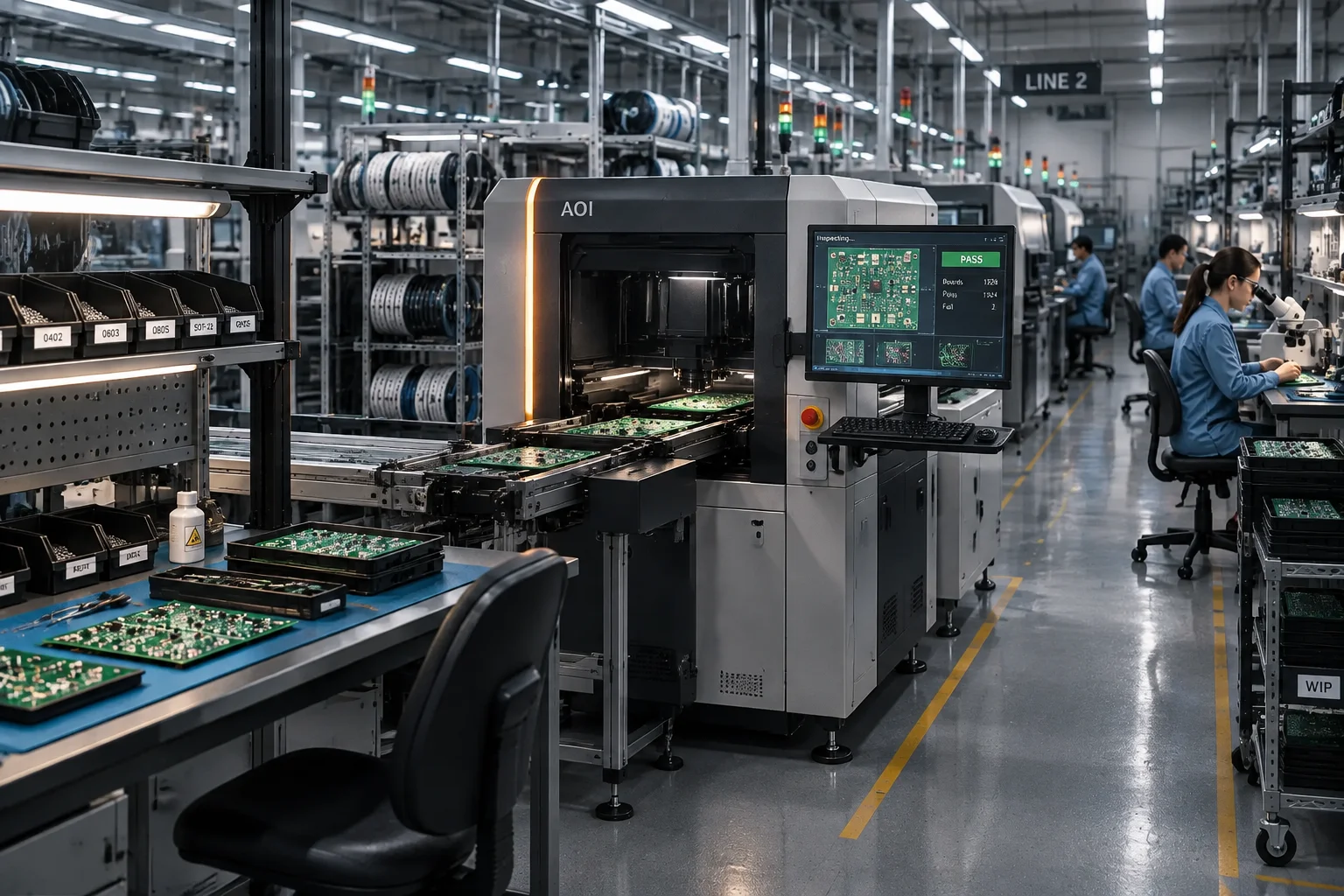
Eleven assembly, inspection, finish and fulfilment disciplines sit on one shop floor in Bayan Lepas, so a programme never travels between suppliers to be finished. Placement starts at 01005 chip components and 0.35 mm leadless pitch, and every SMT build leaves the line through 100% AOI.
Capability index
Each row opens the discipline's own page with its equipment classes, acceptance limits and the engineering questions that decide whether the process fits your design.
| Index | Capability | Technology hooks | Governing figure |
|---|---|---|---|
| CAP-01 | SMT Assembly | 010050.35 mm pitch | 0.42% DPMO |
| CAP-02 | Through-Hole and DIP Assembly | waveselective | 3 DIP lines |
| CAP-03 | Mixed-Technology Assembly | SMT and THTpin-in-paste | 1 panel MOQ |
| CAP-04 | Prototype to Production | NPIvolume bands | 3-5 day prototypes |
| CAP-05 | Component Sourcing and BOM Kitting | authorized distributionAS6081 | 2 sourcing desks |
| CAP-06 | Test Engineering: ICT, Flying Probe, FCT | bed-of-nailsJTAG | 4-8 week fixtures |
| CAP-07 | AOI and X-Ray Inspection | 100% AOI3D X-Ray | <10% BGA void, Class 3 |
| CAP-08 | Conformal Coating | acrylicsilicone | IPC-CC-830B |
| CAP-09 | Cable and Wire Harness | crimpovermould | IPC/WHMA-A-620 |
| CAP-10 | Box Build and System Integration | enclosuresystem FCT | AS9102 first article |
| CAP-11 | Customer Logistics | KanbanVMI | 98.1% on-time delivery |
Envelope
These are the limits the process engineers work to on every quotation. Anything outside them is flagged in the DFM notes before a stencil is ordered.
| Envelope parameter | What this facility runs | Standard or limit |
|---|---|---|
| Minimum chip component | 01005 (0.4 x 0.2 mm) and 0201 passives on chip-shooter lines | IPC-7351B land patterns |
| Minimum leadless pitch | 0.35 mm BGA, micro-BGA, QFN and CSP with vision alignment | 3D X-Ray on 100% of joints |
| Fine-pitch placement accuracy | +/-15-25 um in ultra-fine-pitch mode, +/-30-50 um at full chip-shooter speed | J-STD-001 process control |
| Placement throughput | 40,000-80,000 CPH chip shooters, 3,000-8,000 CPH fine-pitch heads | Per-line capacity planning |
| Board thickness accepted | 0.4-4.0 mm rigid, including 0.6 mm wearable assemblies | Panel support per line |
| Maximum board size | 510 x 460 mm as quoted, against a typical industry line maximum of a 508 x 508 mm panel | Industry-typical range |
| Incoming bare-board layers | 1-32 layers, rigid, flex and rigid-flex | IPC-6012 Class 2 or 3 |
| Solder alloy | SAC305 with a 217 C liquidus, SnPb retained for legacy and defence programmes | J-STD-001 alloy control |
| Stencil thickness | 100 um below 0.4 mm pitch, 120 um standard mixed build, 150 um large thermal pads | Laser-cut, nano-coated |
| Reflow | 10-zone forced convection with soak and ramp-to-spike profiles set per board design | Validated profile per part number |
| BGA void acceptance | Below 25% of ball diameter at Class 2 and below 10% at Class 3 | IPC-7095 |
| Ionic contamination | 1.56 ug NaCl/cm2 maximum at Class 2 and 0.78 ug at Class 3 | ROSE and ion chromatography |
Decision points
Eight topics come up in almost every sourcing review. These are the answers this facility can evidence with a document, a measurement or a date.
OBJ-01 / Lead time
A simple 2-layer prototype runs in 3-5 working days and a complex build in 5-10. Volume production commits 3-6 weeks after material release, gated by component availability rather than line time.
OBJ-02 / MOQ
Zero MOQ on prototypes, so 1 board is a legitimate order. Production releases from 1 panel, and panel quantity is set by annual demand instead of recovering a setup fee.
OBJ-03 / Certification
ISO 9001:2015 and ISO 13485:2016 are held at this site, and IATF 16949 and AS9100D requirements are audited against for automotive and aerospace. Workmanship follows IPC-A-610 Class 2 or Class 3, and a RoHS 3 and REACH declaration is issued with every shipment.
OBJ-04 / IP protection
An NDA is executed before files move. Gerbers, BOMs and test programs sit on an access-controlled server, and ITAR-flagged or export-controlled data follows a documented route with named owners.
OBJ-05 / File formats
Gerber X2 or ODB++, an IPC-2581 export where your CAD tool supports it, a BOM in CSV or XLSX carrying manufacturer part numbers, plus the assembly drawing with polarity and reference designators.
OBJ-06 / Tooling cost
NRE runs $150-500 per order, covering stencil, programming and profile development. A frameless prototype stencil is $30-60 and a framed production stencil $80-200, billed once per revision.
OBJ-07 / Traceability
Panel-level and serial-level records capture laminate lot, component lot and date code, reflow profile and inspection result. Automotive programmes retain those records for 15 years.
OBJ-08 / Payment terms
New programmes run 50% on order and 50% on shipment. After three completed orders the account moves to net-30, with EXW, FOB Penang, CIF, DAP and DDP available as Incoterms.
RFQ flow
Five stages, each with a fixed deliverable and a named owner, so a programme never waits on an unanswered question.
Send Gerbers, BOM, assembly drawing and target quantity. Engineering acknowledges within one working day and lists whatever is missing rather than quoting around a gap.
A CAM check runs against the envelope above: pad geometry, stencil aperture ratio, panel rail, and test-point access on a 1.0 mm pad at a 2.54 mm grid.
The quotation states unit price by volume band, NRE, tooling, test strategy and lead time. Pricing is held for 30 days so your approval cycle does not move the number.
You approve the first article against the drawing, the AOI and X-Ray reports and the functional test log. Any deviation is written up before volume is scheduled.
Production releases against the frozen revision with SPC on the process indicators, and the same panel-level traceability record follows every shipment.
Questions
Zero MOQ on prototypes, so a single panel can be built and tested. Volume programmes release from 1 panel upward, and panel quantity is set by your annual demand rather than by a setup fee.
Gerber X2 or ODB++, an IPC-2581 export where your CAD tool supports it, a BOM in CSV or XLSX carrying manufacturer part numbers, and the assembly drawing with polarity and reference designators.
An NDA is signed before files move, Gerbers and BOMs are held on an access-controlled server rather than email, and ITAR-flagged or export-controlled data follows a documented handling route.
The site is registered to ISO 9001:2015 and ISO 13485:2016 and is audited against IATF 16949 and AS9100D requirements, building to IPC-A-610 Class 2 and Class 3 under ANSI/ESD S20.20 controls.
Seven fields. A process engineer replies within one working day.
Seven fields. A process engineer replies within one working day.
Seven fields. A process engineer replies within one working day.