Sector / Medical devices and diagnostics
PCBA for Medical Devices and Diagnostics
In medical work the board is part of the regulatory submission, so the manufacturing record has to survive an audit years after the shipment. The failures that hurt are not yield failures: they are a laminate substituted between prototype and production, a creepage distance that meets the drawing but not IEC 60601-1, and a traceability chain that stops at the batch.
ISO 13485:2016 registered - FDA 21 CFR 820 practice - IEC 60601-1 - UDI-ready marking - IPC-A-610 Class 3 - 100% AOI with mandatory BGA X-Ray
Buyer pain points
Five regulatory traps that surface after the design freeze
Each row is a quantified compliance failure mode rather than a manufacturing inconvenience. All of them are cheap to prevent at DFM and expensive to find at a notified body review.
| Pain point | The number | Consequence if it is discovered late |
|---|---|---|
| Isolation barrier geometry | IEC 60601-1 2xMOPP at 250 V requires 5.0 mm clearance and 8.0 mm creepage; 1xMOPP is 2.5 mm and 4.0 mm. | Widening the barrier after layout fragments the ground plane, re-opens the EMC test, and can force a board respin during design verification. |
| Dielectric withstand | Reinforced insulation at 250 V must withstand 4000 V AC for 1 minute. | A barrier layer that is too thin passes a functional test and fails hipot on the production line, where every unit is already built. |
| Comparative tracking index | Pollution Degree 2 reinforced insulation needs CTI at or above 400 V, which is Material Group II; standard FR-4 is often only 175-250 V, which is Group IIIb. | A laminate swap between prototype and production is a silent compliance failure that only a material certificate review will catch. |
| Traceability depth | ISO 13485:2016 and FDA 21 CFR 820 require material lot, process batch, inspection, and operator records linked to a UDI. | Batch-level traceability cannot support a field corrective action, so a suspect lot becomes every unit ever shipped. |
| Cost of compliance | IEC 60601-1 plus Class 3 typically adds 2.5-4x to bare-board cost. | A programme costed on standard FR-4 and Class 2 inspection absorbs the difference as margin, or re-quotes the customer after the design freeze. |
programme      MED-3308 - 8-layer, Tg 180 C, high-CTI, halogen-free
application    Class II diagnostic instrument, mains-powered
insulation     2xMOPP at 250 V working voltage
clearance      PASS  5.2 mm measured against the 5.0 mm minimum
creepage       PASS  8.4 mm measured against the 8.0 mm minimum
withstand      PASS  4000 V AC, 60 s, no breakdown, no flashover
laminate      CTI 600 V Material Group I, locked in the traveller
inspection    IPC-A-610 Class 3, 100% AOI, 100% X-Ray on BGA and QFN
contamination PASS  0.44 ug NaCl/cm2 against the 0.78 ug Class 3 limit
cross-section 4 locations this lot, minimum is 2
records       DHR-indexed, serialized, 510(k) file material attached
How the build is run
A documentation package built to be filed, not reformatted
Material specification lock
The laminate is the part of a medical build most likely to be substituted quietly, because a Group IIIb FR-4 and a Group I high-CTI laminate look identical on the shop floor. We lock the material group, the CTI value, the glass-transition temperature, and the halogen-free construction into the traveller at award, and any change runs through a documented change control with the regulatory impact stated before it is released. On a stocked panel the certificate of conformance names the laminate lot and date code rather than the generic family.
Isolation control through the process
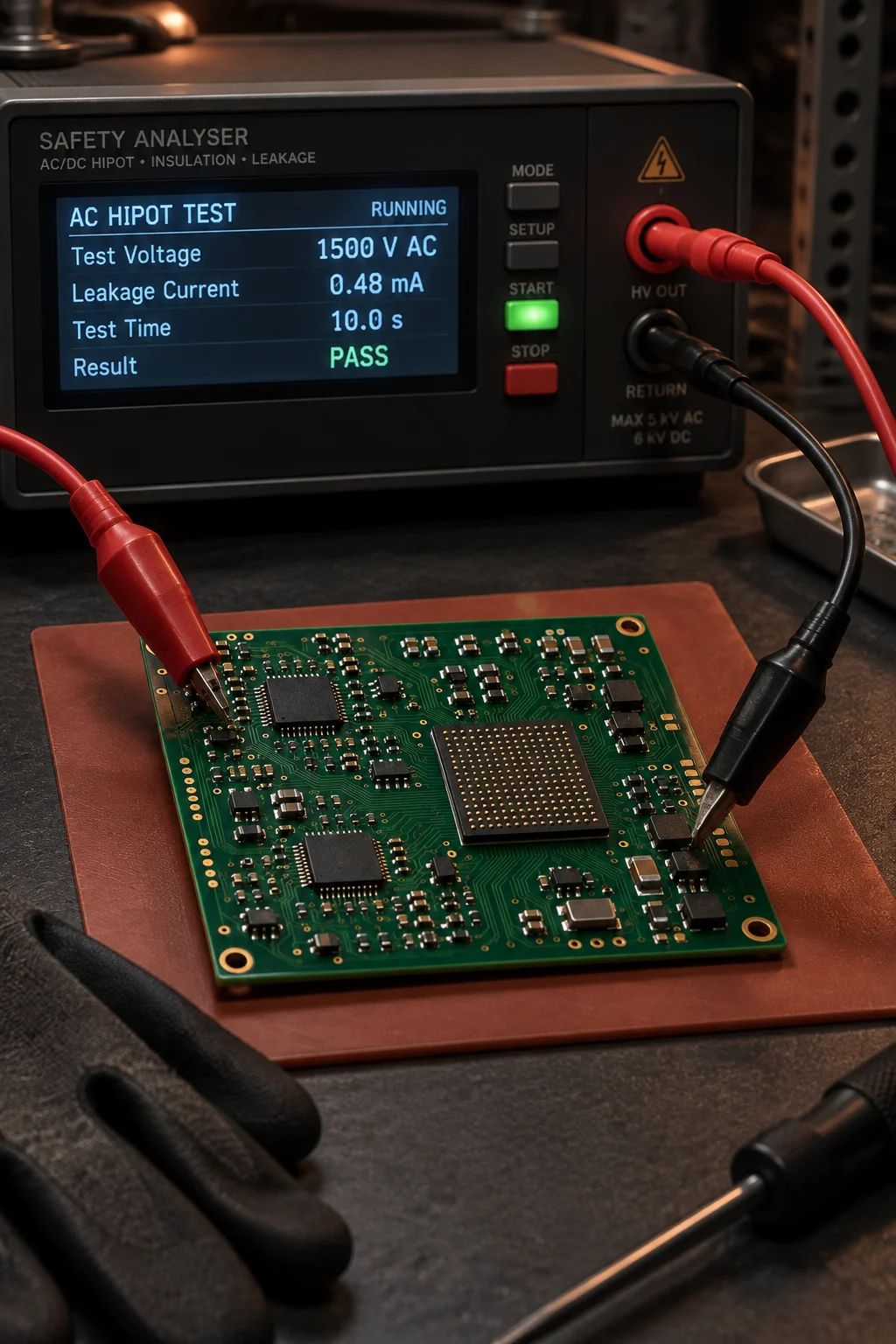
A 2xMOPP barrier at 250 V costs 5.0 mm of clearance and 8.0 mm of creepage, which is real estate taken out of the ground plane. The gap is reviewed at DFM against IEC 60601-1 and then protected through assembly: no coating shadowing across the barrier, no flux residue allowed to bridge it, and connectors masked so capillary ingress cannot carry contamination into the channel. Every unit built for a mains-connected device is hipot tested at 4000 V AC for one minute, and the pass record is attached to the serial number rather than the batch.
Traceability that answers a field action
Traceability in medical work is not a barcode, it is the ability to answer a regulator's question about one unit. We mark every board with a laser Data Matrix linked to the panel ID, the reflow profile, the AOI and X-Ray results, the coating batch, and the operator at the critical steps, which is what a UDI ultimately resolves to. Material lots are recorded per board rather than per order, so when a supplier issues a notice covering a specific date code, the affected units can be listed without quarantining everything built that year.
Requirements to capability
Medical requirement to capability mapping
ISO 13485 and FDA 21 CFR 820 requirements sit alongside the electrical and material requirements, because both are audited on the same manufacturing record.
| Requirement | Governing standard | What we do | Evidence |
|---|---|---|---|
| Quality management system | ISO 13485:2016, FDA 21 CFR 820 | Registered ISO 13485:2016 QMS with design-transfer, purchasing, process-validation, and CAPA procedures audited against 21 CFR 820 subparts. | Current certificate and audit history |
| Material group and tracking index | IEC 60601-1, IEC 60112 | High-CTI laminate at 600 V Material Group I standard for mains barriers, with the material group locked in the traveller so it cannot be substituted between prototype and production. | Laminate certificate naming the CTI value and lot |
| Clearance and creepage | IEC 60601-1, IEC 60664-1 | DFM review of the isolation barrier against 5.0 mm clearance and 8.0 mm creepage at 2xMOPP and 250 V, with the ground-plane fragmentation reported before layout release. | Barrier measurement report and DFM notes |
| Dielectric withstand | IEC 60601-1 clause 8.8 | 100% hipot at 4000 V AC for 1 minute on mains-connected assemblies, with the barrier layer thickness specified at 8 mil minimum and 12-15 mil preferred. | Serialized hipot pass record |
| Workmanship class | IPC-A-610 Class 3, J-STD-001 Class 3 | Class 3 build with 100% inspection and no sampling, tight annular ring and conductor reduction limits, and a rejection band that widens from 2-5% to 8-15%. | CIS-certified inspection record per panel |
| Hidden-joint inspection | IPC-7095, IPC-A-610 Class 3 | 100% AOI plus mandatory X-Ray on every BGA and QFN, holding voids under 10% of ball diameter at Class 3 where AOI is blind to the joint. | X-Ray images retained per serial number |
| Material content restrictions | IEC 61249-2-21, RoHS 3, REACH SVHC | Halogen-free laminate and UL 94 V-0 flame rating on medical builds, with RoHS 3 and REACH SVHC declarations carried on the bill of materials. | Material declaration per shipment |
| Climate and contamination testing | IPC-TM-650 2.6.25 | CAF testing at 85 C and 85% RH for 500 hours with 50 V bias, accepting no resistance drop below 100 MOhm, and ionic contamination under 0.78 ug NaCl per square centimetre at Class 3. | CAF and ionic contamination certificates |
| Thermal reliability | IPC-9701 | Thermal cycling from -55 C to +125 C for 200 cycles on non-life-support devices and 500 or more for life-support devices, with cross-sections at 2 minimum per lot. | Cycle report and cross-section images |
| Sterilization exposure | ISO 11135, ISO 11137 awareness | Autoclave exposure at 134 C for 18 minutes for sterilizable devices, with board-level survival verified before the assembly is released. | Autoclave exposure record |
| Unique device identification | FDA UDI rule, EU MDR 2017/745 | Laser-marked Data Matrix on every board linked to the manufacturing record, sized for the device label rather than the panel. | Marking verification and traceability file |
| Process validation | ISO 13485:2016 clause 7.5.6 | IQ, OQ, and PQ support for reflow, coating, and cleaning, since a validated process is the only defence when a parameter drifts mid-campaign. | Validation protocol and report set |
| Record retention and device history | ISO 13485:2016 clause 4.2.5, 21 CFR 820.180 | Device-history-record retention keyed to the serial number, with the package indexed for a 510(k) or CE technical file rather than stored as a shipping document. | DHR index and retrieval test |
Documentation control
Documentation and traceability checklist
This is the package we assemble for a medical build. It is presented here with the acceptance values, so a quality engineer can see what arrives before the first shipment.
Laminate material record
Laminate supplier, grade, CTI value, material group, glass-transition temperature, lot, and date code, recorded against the panel. The record names the material group, because a 175-250 V Group IIIb board and a 400 V Group II board can share the same generic part number family.
Solder alloy lot
Alloy type and lot for every paste and wire batch, with the SAC305 liquidus confirmed at 217 C for volume work and SnPb kept in a segregated cell for legacy programmes. A lot change inside a device family is a change-control event rather than a routine purchase.
Component certificates
Certificates of conformance for purchased parts, restricted to authorized distribution and original manufacturers, with microscopy, X-Ray, and XRF results attached for every new material lot. Broker and open-market purchases are not used on a medical programme.
Process traceability
Reflow profile ID against the board design, stencil foil thickness, cleaning batch, coating run with coupon thickness, and operator identification at the critical steps. Every record resolves to a panel ID, and every panel ID resolves to the serial numbers marked on its boards.
Inspection and test evidence
AOI pass record at 100% coverage, X-Ray images on every BGA and QFN with void percentage against the 10% Class 3 limit, hipot at 4000 V AC for one minute, and ionic contamination against 0.78 ug NaCl per square centimetre.
Cross-section verification
A minimum of 2 cross-sections per lot, with recent Class 3 medical lots measured at 3 and 4 locations. Annular ring, conductor width reduction, and plated through-hole copper at 25 um or better are recorded against the drawing rather than summarised.
Reliability qualification
CAF results at 85 C and 85% RH for 500 hours with 50 V bias and no resistance drop below 100 MOhm, thermal cycling from -55 C to +125 C for 200 cycles or 500 plus on life-support devices, and autoclave exposure at 134 C for 18 minutes where the device is sterilized.
Change control
Any change to laminate, solder alloy, coating, or a purchased part is raised against the regulatory file before release, with the customer notified inside the agreed change-notification window. A silent substitution is the failure mode this step exists to prevent.
Release documentation
Certificate of conformance per shipment, serialized traceability data in a machine-readable form for the device history record, and a statement of the standard and class the assembly was built to. Retention is keyed to the serial number, with an annual retrieval test logged.
Programme record
A diagnostic instrument rescued from a laminate substitution
Presented with the four elements: sector, requirement, what we did, and the result in numbers.
Record
- Sector
- Clinical diagnostics
- Programme
- MED-3308
- Volume
- 9,000 units per year
- Class
- IPC-A-610 Class 3, ISO 13485:2016
Requirement
An 8-layer mains-powered analyser board with a 2xMOPP isolation barrier at 250 V, a Class II regulatory pathway, and a device history record that had to be assembled per unit. The transferred design had been prototyped on standard FR-4 at CTI 175-250 V, which cannot support Pollution Degree 2 reinforced insulation at the 400 V Group II requirement.
What we did
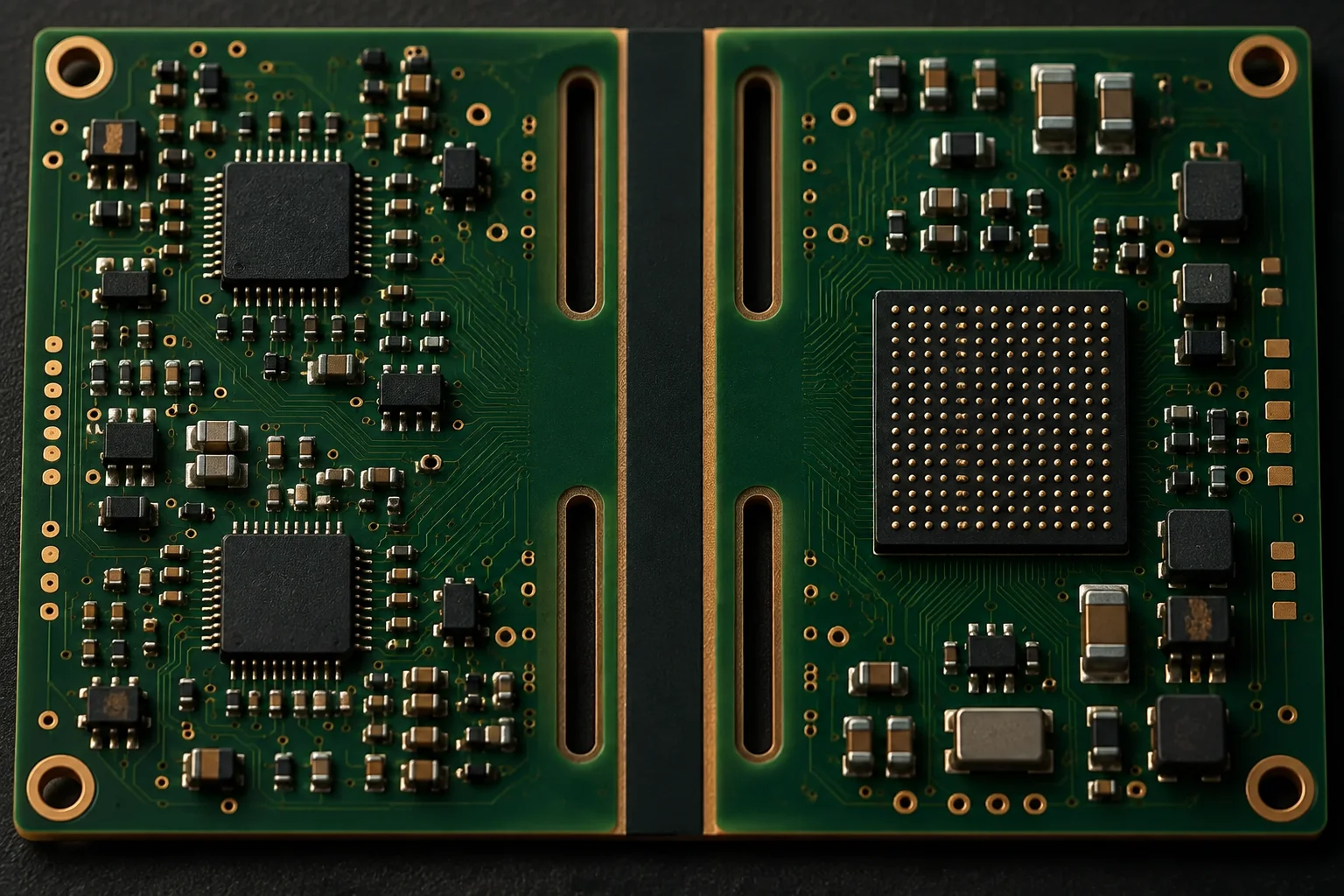
Re-specified the stackup on high-CTI halogen-free laminate at 600 V Material Group I and locked the material group in the traveller. Re-cut the isolation channel to 5.2 mm clearance and 8.4 mm creepage, rebuilt the offending ground plane as two stitched regions, and re-ran EMC pre-compliance on the revised layout. Added 100% hipot at 4000 V AC, per-serial X-Ray on the two QFN devices, and per-unit DHR indexing.
Result
The barrier passed hipot at 4000 V AC for 1 minute on 100% of the first production lot with no flashover. Clearance measured 5.2 mm and creepage 8.4 mm against the 5.0 mm and 8.0 mm minima. BGA void content measured a 6.1% maximum against the 10% Class 3 limit, ionic contamination came in at 0.44 ug NaCl per square centimetre against the 0.78 ug limit, and 4 cross-sections were taken this lot against a minimum of 2. The revised layout held its EMC pre-compliance margin, and bare-board cost rose 3.1x against the original prototype quote, inside the typical 2.5-4x industry band for IEC 60601-1 and Class 3 compliance.
Buyer questions
Records, laminate control, and compliance cost
Every medical programme ships with material certificates and lot codes, panel and serial traceability, AOI and X-Ray results linked to the serial number, ionic contamination data against the 0.78 ug NaCl per square centimetre Class 3 limit, a minimum of 2 cross-sections per lot, and a certificate of conformance. The package is indexed so it can be lifted into a device history record or a 510(k) and CE technical file rather than reformatted.
Yes, and it is the single most common silent compliance failure we see. Pollution Degree 2 reinforced insulation needs CTI at or above 400 V, which is Material Group II, while standard FR-4 is often only CTI 175-250 V, which is Group IIIb. We lock the laminate specification and the material group in the traveller at award, so the CTI cannot be substituted between the prototype run and production without a documented change.
Medical compliance can add 2.5-4x to bare-board cost, driven by the laminate material group, the wider isolation gaps that fragment the ground planes, halogen-free construction, Class 3 inspection with 100% coverage, and the documentation package. Assembly itself carries a typical 20-40% Class 3 premium over Class 2 because the rejection band widens from 2-5% to 8-15% and no sampling is allowed.