Capability / Component sourcing and kitting
Component Sourcing and BOM Risk Control
Most assembly failures we are asked to investigate are not solder failures. They are a line bought outside authorized distribution, a moisture-sensitive package that was never baked, or a date code that cannot be traced back to a reel. Sourcing is the part of the build where the risk is decided, and it is decided before the first panel reaches the printer.
Sourcing policy
Sourcing policy matrix: source type, evidence and lead time
Every purchased line is classified into one of fourteen tiers before it is ordered. The tier fixes which documents have to exist, which test the part has to survive, and what lead time can honestly be quoted to you.
| Tier | Source type | Evidence required before release | Typical lead time |
|---|---|---|---|
| T-01 | Authorized distributor, in stock | Franchised invoice naming the manufacturer, certificate of conformance, lot and date code, RoHS 3 declaration | 3-10 days |
| T-02 | Authorized distributor, bonded stock | Bonded-store agreement plus the same certificate set, with the bin reserved against our programme | 0-5 days from bin |
| T-03 | Authorized distributor, backorder | Written allocation acknowledgement with a factory commit date, refreshed weekly | 8-20 weeks |
| T-04 | Original manufacturer, direct | Manufacturer certificate of conformance, PCN enrolment, MSL rating from the released datasheet | 10-26 weeks |
| T-05 | Original manufacturer, scheduled NCNR | Non-cancellable order acknowledgement, PCN and EOL notification route agreed in writing | 12-30 weeks |
| T-06 | Manufacturer engineering sample | Engineering-sample certificate and a written limit on production use, or the line is reclassified | 3-15 days |
| T-07 | Franchised excess with manufacturer consent | Resale authorisation letter, full lot history from the original shipment, unopened reel seals | 1-3 weeks |
| T-08 | Qualified second source | Form-fit-function qualification report covering footprint, electrical limits and thermal behaviour | 6-12 weeks including qualification |
| T-09 | Customer-consigned stock | Incoming count against the packing list, customer certificate of conformance, quarantine until counted | 24-48 h to the line |
| T-10 | Independent distributor, test verified | AS6081-aligned report: XRF plating check, X-Ray, decapsulation, curve trace, plus customer sign-off | 1-2 weeks |
| T-11 | Independent distributor, untested | Not accepted on any programme. No evidence set exists that would release this tier | Not quoted |
| T-12 | Open market, obsolete or allocated part | AS6081 report plus destructive physical analysis on a sample, retained as a per-lot record | 2-4 weeks |
| T-13 | Last-time-buy position | PCN or EOL notice copy, agreed lifetime quantity, bonded or in-house storage with a re-bake plan | 12-20 weeks |
| T-14 | Turnkey BOM kit from this facility | One consolidated certificate set per kit, panel-linked kit record, discrepancy report at kitting | 3-6 weeks after material release |
BOM risk scan
A risk scan that stops four lines before they are ordered
The scan runs against the manufacturer part numbers in your BOM and returns a disposition per line. Four flagged lines from a recent industrial programme are shown below, exactly as the report reaches the buyer.
programme      IND-4417 - 6-layer controller, 412 lines, 148 unique MPN
scan scope     lifecycle, allocation, package, MSL, date code, AVL source
result         4 flagged lines, 408 clean, 0 blocked

FLAG 1  U17  MPN 32-bit MCU, 144-LQFP
        reason   single source, life-cycle status end-of-life per PCN 2025-041
        action   last-time-buy 14,000 pcs for 18 months of demand, or qualify T-08 alternate
FLAG 2  U4   MPN 2.4 GHz transceiver, QFN-32
        reason   MSL 3, 168 h floor life; carrier opened on the previous build
        action   bake 24 h at 125 C, re-seal with desiccant, floor-life clock restarted
FLAG 3  R22-R41 MPN 0402 1% 10k
        reason   date-code spread 31 months across four reels in one kit
        action   consolidate to a single date code, or record the spread in the panel file
FLAG 4  D2   MPN Schottky 40 V, SMA
        reason   AVL names an unfranchised source with no test report attached
        action   move to T-01 or T-10; the untested route is not released for this programme

clean          408 lines carry a franchised source, a single date code and an MSL rating
records        flag dispositions signed by the buyer before the kit is released
RELEASED       4 of 4 flags dispositioned, kit released to kitting on 2026-03-11
How sourcing is run
Authorized distribution first, with the exceptions written down
Authorized distribution is the default, not a preference
Roughly nine lines in ten are bought through franchised distribution, which is the only route that arrives with a manufacturer invoice, a single date code and an intact warranty. The Shenzhen sourcing desk exists to price and date the alternative, not to bypass the franchise. When a line genuinely cannot be bought in franchise, it is raised as a documented exception with an AS6081-aligned test report, and it does not move to the line until a named buyer has signed the disposition. The trade arithmetic behind that discipline is blunt: Section 301 adds 25% on many China-origin lines and the old 800 US dollar de-minimis clearance is gone, so a cheap broker reel is rarely cheap once duty, test and a possible rework cycle are added.
BOM scrubbing before the first purchase order
The scrub reads the BOM the way a purchasing engineer would, line by line, and returns a disposition rather than a warning list. It looks for single-source and end-of-life status, allocation history across the franchised channel, package and footprint mismatches against the assembly drawing, moisture sensitivity level, date-code spread inside one kit, and any alternate in the approved vendor list that has no evidence attached. Lines that carry a duplicate part number with two different footprints, or a footprint that disagrees with the land pattern, are caught here because they cost a reflow cycle rather than a phone call if they reach the line.
Second sources and form-fit-function alternatives
A second source is only a second source once it has been qualified, so the qualification covers footprint and land pattern, electrical limits across the full operating range, thermal behaviour under the programme profile, and any firmware or timing dependency that the datasheet does not make obvious. Where an exact alternate does not exist, a form-fit-function candidate is proposed with the differences stated in writing, including whichever specification it does not meet. Where nothing qualifies, the honest answer is a last-time-buy with an agreed quantity and a storage plan, and that answer is more useful than a substitute nobody signed off.
Traceability gap
Grey market against authorized distribution, on the same six checks
The comparison is deliberately narrow. Both columns describe the same six checks, and the only difference is how much of each check has to be manufactured after the part has already been bought.
| Check | What the record shows |
|---|---|
| Chain of custody | Franchised invoice naming the manufacturer and the OCM part number, unbroken from the factory to our receiving dock. |
| Date code | A single manufacturing date code per reel where the manufacturer allows it, normally inside a 12-month spread across the whole kit. |
| Lot traceability | Lot or batch code printed on the reel label, transcribed at kitting and carried into the panel and serial record. |
| Paperwork | Certificate of conformance, RoHS 3 and REACH declaration, and the MSL rating taken from the released datasheet. |
| Counterfeit cover | Purchasing restricted to the franchise channel, which removes the incoming test burden from the buyer entirely. |
| Warranty position | The manufacturer component warranty survives, so a defect is a supplier claim rather than a programme write-off. |
| Check | What has to be created |
|---|---|
| Chain of custody | A resale authorisation letter or a documented exception signed by the buyer, because the invoice alone proves nothing about origin. |
| Date code | A measured date-code spread, which is regularly 24 months or more on one kit and has to be recorded per reel rather than assumed. |
| Lot traceability | A per-lot record created by us: reel photographs, label transcription, and a lot number that only exists internally. |
| Paperwork | A test report instead of a certificate: XRF plating check, X-Ray of the package, decapsulation of a sample and a curve trace. |
| Counterfeit cover | AS6081-aligned incoming test on every lot, plus destructive physical analysis on a sample where the part is obsolete. |
| Warranty position | No manufacturer warranty, so a field failure caused by the part is absorbed by the programme rather than claimed back. |
The right-hand column is not a rejection of the whole channel. It is the work that has to be done, and priced, before an unfranchised part is equivalent to a franchised one.
Sourcing flow
From released BOM to a kit that is ready for the line
Five stages, each with a named deliverable. The moisture-sensitivity and date-code work sits at the fourth stage, because that is the first point at which a physical part exists to be checked.
BOM scrub and tier classification
Every line is classified into one of the fourteen sourcing tiers and checked for lifecycle status, allocation history, footprint agreement and approved-vendor evidence. Output is a disposition per line, not a warning list, and the buyer signs it before anything is ordered.
Franchise pricing and allocation check
Two franchised distributors price each line and confirm stock position, so the quoted lead time reflects a real factory commit rather than a catalogue page. Where allocation applies, the commit date is refreshed weekly and the programme schedule is revised against it rather than against hope.
Second-source and FFF qualification
Alternates are qualified against footprint, electrical limits across the operating range, thermal behaviour and any firmware dependency. A form-fit-function candidate is proposed only with the specification it does not meet stated in writing, and nothing is substituted inside a part family without a change notice.
MSL routing, bake and dry-pack
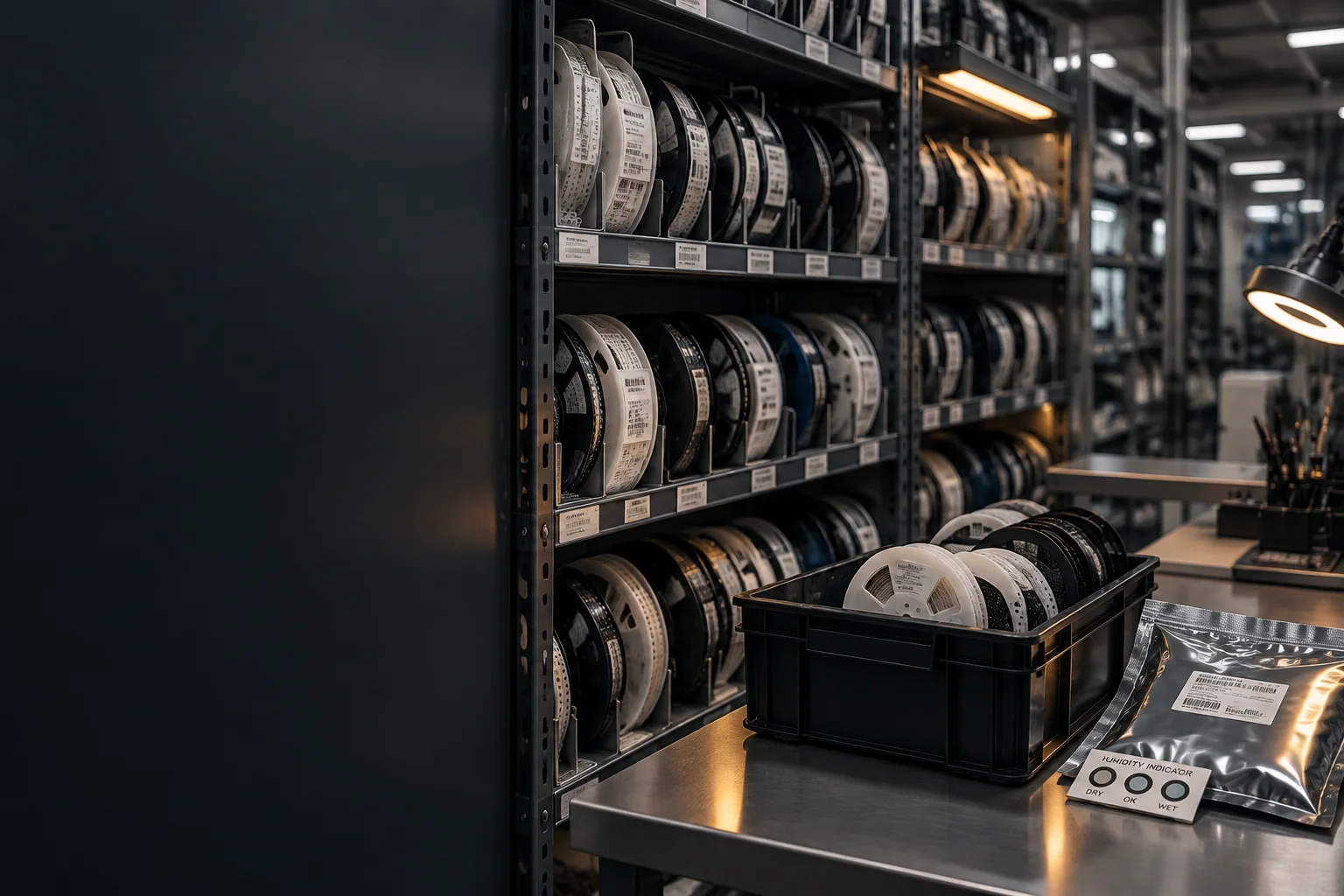
A moisture-sensitivity level of 3 allows 168 hours of floor life after the carrier is opened; level 4 and above is measured in tens of hours. Opened carriers are logged, the floor-life clock is tracked per reel, and any part that exceeds it is baked at 125 C for 24 hours and re-sealed with desiccant before it goes to the line.
Kitting, lot capture and release
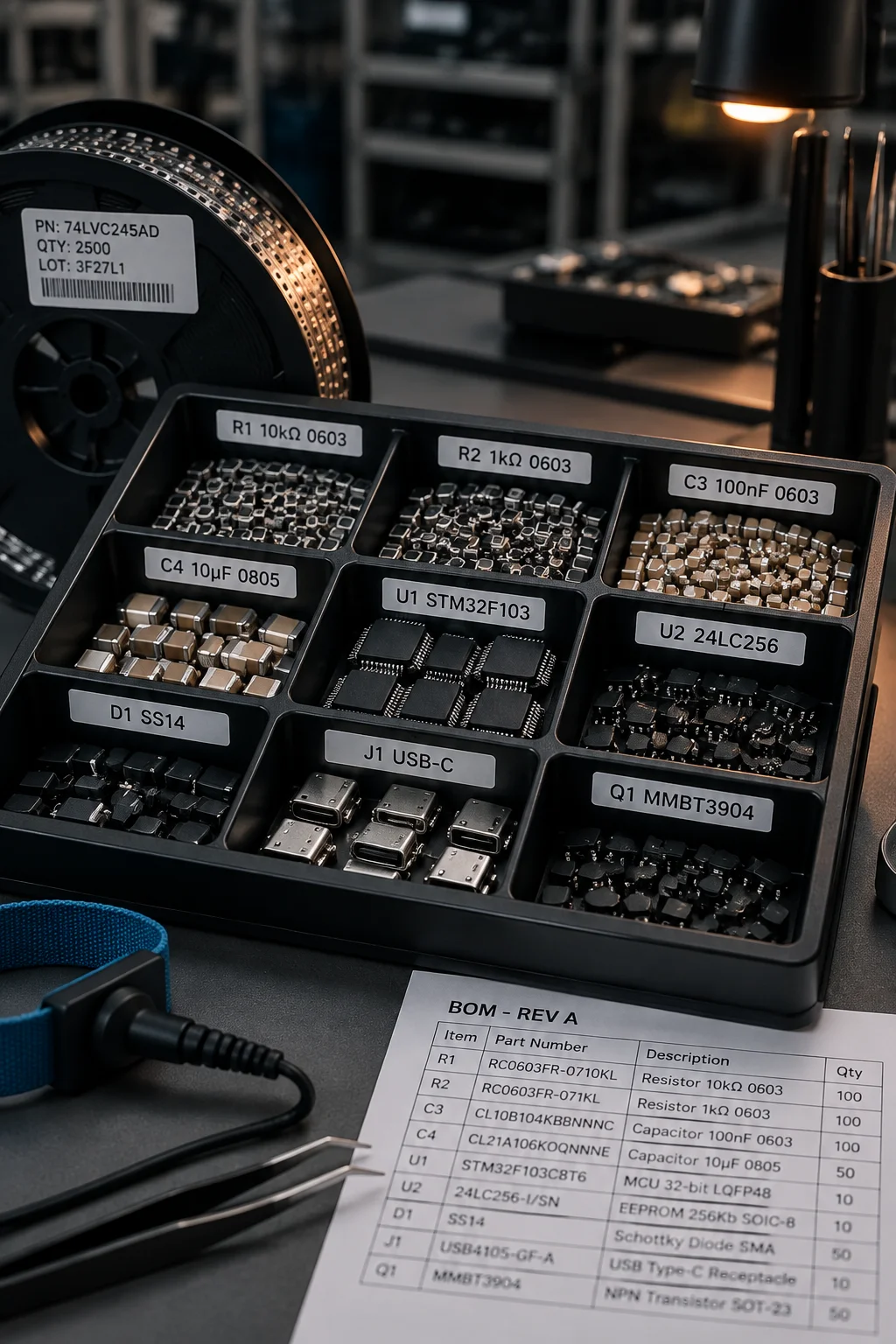
The kit is built against the panel quantity with a two-piece overage on passives, and every reel label is transcribed into the kit record with its lot and date code. Discrepancies are reported at kitting rather than discovered at the feeder, and the released kit is traceable from panel number back to the individual component lot.
Macro record
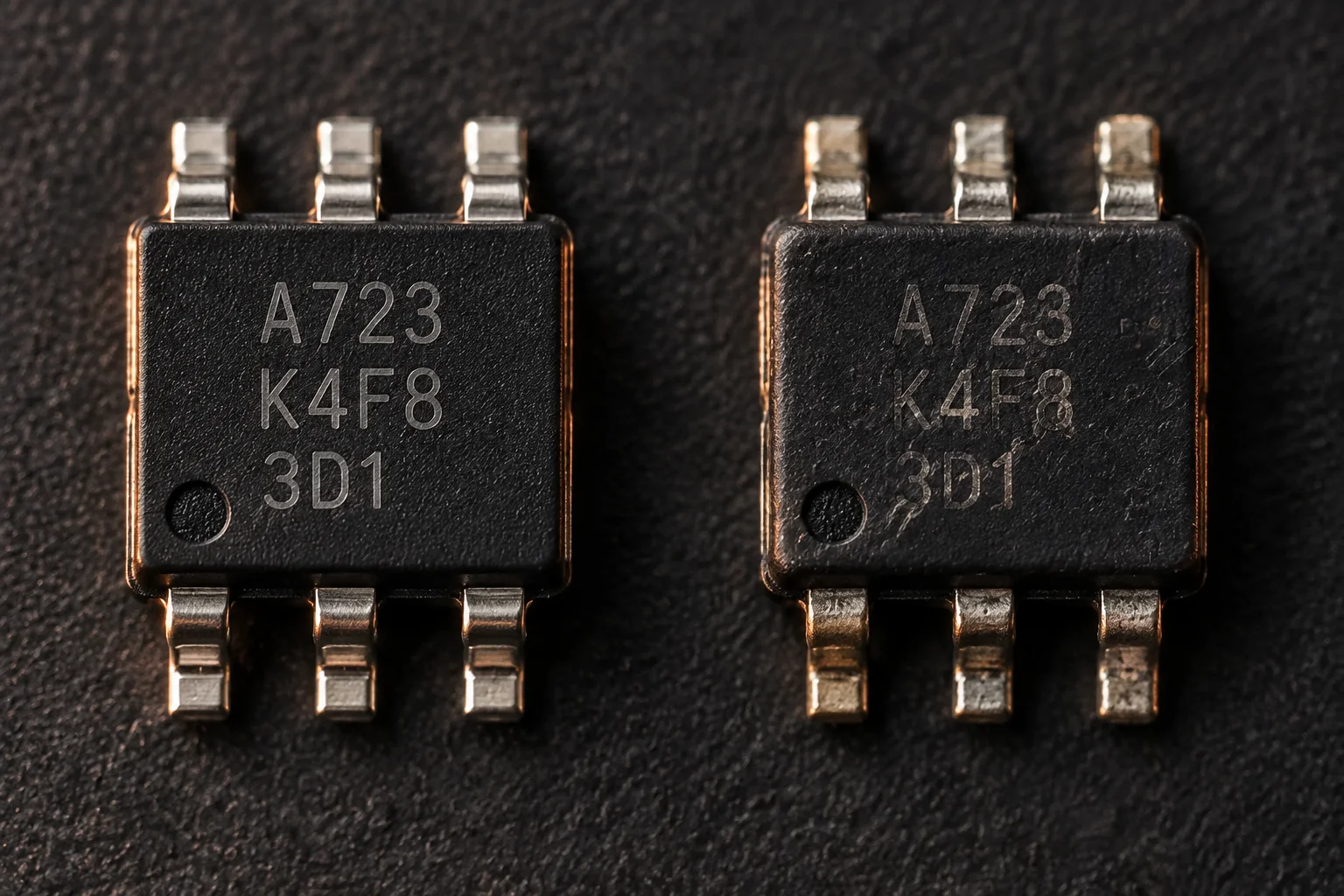
Two packages that look alike and are not
A counterfeit is usually a correct-looking package carrying the wrong die, the wrong plating or a re-marked date code. Under magnification the tell is in the mould marks, the lead finish and the laser marking depth, which is why incoming screening photographs every lot at this scale.
Buyer questions
Source evidence, obsolescence and who pays the duty
Every purchased line carries a franchised-distributor invoice that names the original manufacturer and the OCM part number, and that invoice copy is filed against the panel record. The reel label carries the lot or batch code and the date code, and both are transcribed into the kit record at kitting rather than at receiving. Where a line genuinely cannot be bought through authorized distribution, it moves to a documented exception with an AS6081-aligned test report covering XRF, X-Ray, decapsulation and curve trace, and the customer signs the exception before the part is released to the line.
The line is raised in the BOM risk scan as soon as a PCN or EOL notice arrives, or as soon as a distributor shows zero inventory across the franchised channel. The response is one of four: a pin-compatible second source qualified as a form-fit-function alternate with a qualification report, a last-time-buy quantity agreed against the remaining programme life, a buffer or bonded stock position held at the distributor, or a documented design change. What we do not do is substitute a part inside the same family without telling you.
The exemption that used to clear shipments under 800 US dollars duty-free is gone under Executive Order 14324, implemented at 90 FR 42418, and that applies to every country rather than to one origin. For a consigned or customer-supplied BOM the duty is the importer's, which is normally you. For a turnkey build we quote FOB Penang by default and can quote DDP where you would rather see one landed number. Section 301 adds 25% on many China-origin lines, which is why the Shenzhen sourcing desk is used for comparison rather than as a default.