Enquiry desk / Plot 118, Bayan Lepas, Penang
Request a Quote
A quotation needs six inputs and no ceremony: the fabrication data, the bill of materials, the placement file, the annual quantity, the date you need boards, and the workmanship class you are buying. Send those and the reply carries a price that expires 30 days after issue, the schedule this plant will actually hold to, and the DFM findings that could move either of them.
Desk hours 09:00 to 18:00 MYT, Monday to Friday - sales@genesiscircuits.com - +60 4 555 0182
How an RFQ runs
Four steps from your first email to a priced quotation
Nothing in the sequence is billable, and each step names what the desk needs from you before it can move to the next one.
Send the six inputs
What we need: Gerber data with the NC drill file, a BOM carrying manufacturer part numbers, a pick-and-place file, the annual and first-order quantity, the date boards are needed, and the workmanship class. A photo of the assembled prototype helps when the drawing is ambiguous.
DFM and input check
What we need: nothing further unless the review finds a gap. A process engineer checks the panel layout, the aperture ratios, the courtyard clearances and the lifecycle status of every part on the BOM, then returns the mark-up together with a list of any file still outstanding before pricing begins.
Costed quotation
What we need: confirmation of the quantity band and the destination country, because both move the price. The quotation breaks out components at cost, placement, NRE, test development and freight, names the Incoterm, and holds the unit price for 30 days.
Order, tooling and first article
What we need: a purchase order, and payment terms confirmed if the programme is new to the plant. Stencils, fixtures and programs are raised, the first article is built and inspected to the class on the quotation, and volume release follows your approval.
Enquiry form
Send the requirement, or reach the desk directly
Seven fields, all of them things the quoting desk would ask for on the first call. Attachments follow by email once the enquiry is logged.
What are you building?
Or reach the desk directly
Quotation questions, DFM findings and order status all run through the same desk. A named engineer owns each enquiry from the first reply to the release of volume.
| sales@genesiscircuits.com | |
| Telephone | +60 4 555 0182 |
| Address | Plot 118, Bayan Lepas Free Industrial Zone, 11900 Penang, Malaysia |
| Desk hours | 09:00 to 18:00 MYT, Monday to Friday |
| Component desk | Second sourcing desk in Shenzhen for allocation and lifecycle checks |
Quote inputs
What to send so the first price is the usable one
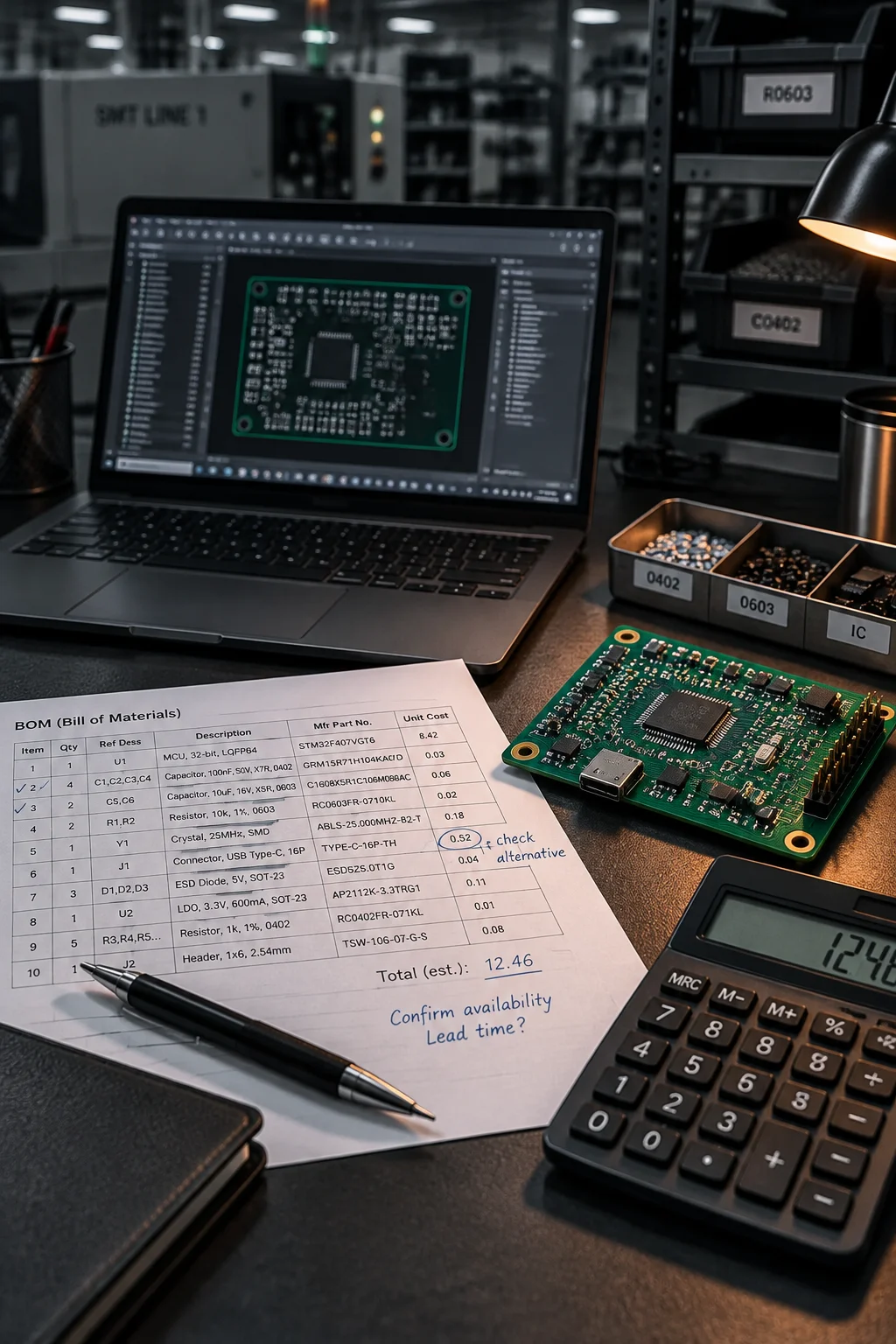
A quotation built on partial data carries assumptions, and assumptions move the price. Each row below names one input, the form to send it in, and what the quotation does differently when it is missing.
| Input | Form to send it in | What the quote assumes if it is missing |
|---|---|---|
| Gerber data | RS-274X or X2 plus the NC drill file; ODB++ or IPC-2581 if your CAD tool exports it | Panelisation, stencil aperture and placement cost are estimated from the drawing, so the placement line carries a margin for guesswork |
| Bill of materials | CSV or XLSX with manufacturer part numbers, reference designators and quantities per board | Components are priced from a generic category, and no lifecycle check can be run before you commit |
| Pick-and-place file | CSV or the native CAD export, with reference designator, X and Y coordinates and rotation | The placement count comes from the BOM only, which undercounts parts sharing a line item |
| Test specification | Coverage you need from AOI, X-Ray, in-circuit test, flying probe or functional test, with limits where you have them | AOI and X-Ray are quoted by default and electrical test is left as an option, which delays the test development clock |
| Target volume | First-order quantity and annual demand, split by release if the programme is seasonal | A single mid-band quantity is priced, and the panel layout may not suit the real release pattern |
| Target date | The date boards are needed at your dock, plus any hard launch or trade-show date behind it | The standard lead time is quoted with no expedite premium and no allocation risk flagged |
| Target cost | The unit cost the programme has to hit, and which of placement, material or test may be traded against it | Cost-down work is quoted as a separate exercise after the first build instead of before it |
| Certification class | IPC-A-610 Class 2 or Class 3, and any sector standard such as ISO 13485, IATF 16949 or AS9100D | Class 2 with standard documentation is assumed, and a later move to Class 3 re-prices the assembly by 20 to 40% |
| Packaging | ESD bag, tray, tube, reel or a customer carrier, with the label format you need | Standard ESD bagging with desiccant is quoted, which may not fit your line-side presentation |
| Incoterms and destination | The Incoterm you want and the delivery country, town and postal code | EXW Penang is quoted, which leaves freight, duty and clearance off the price you compare |
Price bands
Typical industry bands behind a contract assembly price
Every figure below is a typical industry band for contract electronics assembly rather than a quotation, and none of it is an offer. They are published so you can sanity-check a quotation line by line instead of comparing one bottom-line number with another.
| Cost or time element | Typical band | What moves it |
|---|---|---|
| NRE per order | 150 to 500 USD | Number of unique part numbers, stencil count and whether a first-article report is required |
| Passive placement | 0.005 to 0.015 USD each | Pitch, placement count and line speed; 01005 and 0201 parts sit at the top of the band |
| Micro-BGA placement | 0.10 to 0.50 USD each | Ball count, pitch, X-Ray verification and rework risk on a fine-pitch device |
| Example board economics | 40 to 80 USD at 1 to 5 pieces, falling to 3 to 7 USD at 1,000 or more | A 200-placement board, where material dominates at low volume and machine time dominates at high volume |
| In-circuit test fixture | 2,000 to 50,000 USD, 4 to 8 weeks to build | Probe count, board size, fixture mechanism and how much of the netlist is reachable |
| Functional test fixture | 1,000 to 10,000 USD, 1 to 2 weeks to build | Instrumentation, load simulation, and how much of the test is automated rather than operator-run |
| Flying probe | 3 to 10 USD per board, no fixture | Net count and test time; used at prototype and low volume where a fixture cannot be justified |
| Class 3 premium | 20 to 40% over Class 2 assembly | 100% inspection instead of sampling, tighter annular ring and conductor limits, and a wider rejection band |
| Prototype lead time | 3 to 5 working days simple, 5 to 10 days complex | Component availability, layer count, fine-pitch content and whether tooling already exists |
| Volume lead time | 3 to 6 weeks after material release | Long-lead semiconductors, fixture readiness, and whether the programme needs a first article before release |
Buyer questions
Turnaround, commitment, terms and freight
A complete data package gets a priced quotation inside 48 hours on working days. Complete means Gerbers with a drill file, a BOM carrying manufacturer part numbers, a pick-and-place file, a quantity and a target date. Where a file is missing you get the DFM list back instead, naming exactly what is needed, usually inside one working day.
No. A quotation is a priced offer held for 30 days with the Incoterm named on it, and no purchase order exists until you raise one. Files can be sent under NDA before release, and a design that is quoted and then shelved costs nothing.
A new programme runs 50% on order and 50% on shipment, which is the usual band for a first contract build. After three completed orders we move to net-30 on approved credit. NRE and any tooling are invoiced with the first order because both are consumed before production starts, and all invoices are issued in USD.
EXW, FOB Penang, CIF, DAP and DDP are all available, and the quotation names the one it is priced on. Air freight from Penang reaches North America in 3 to 6 days and Europe in 4 to 7 days. Because the US 800 USD de-minimis exemption has been withdrawn, air shipments of any value now clear as formal entries, so duty and clearance costs are quoted separately rather than folded into the board price.
Response promise
What the desk commits to on every enquiry
These are the three dates and durations the quoting desk is measured on, taken from the last four quarters of enquiry logs.
Measured from the moment all six inputs are in hand, on working days. 91% of enquiries closed inside this window in the last four quarters.
A named engineer answers DFM questions and the missing-file list within one working day, whether or not the programme is ready to be quoted.
Component costs move, so a quotation carries the price it was built on and the date it expires rather than being reissued quietly.