Packed cartons and ESD totes staged on a despatch dock beside a shrink-wrapped pallet under low light

Capability / Fulfilment and customer logistics

Flexible Order Fulfilment: Kanban, VMI and Consignment

Once a design is released the argument moves to cash and to risk. Holding stock at your line removes your carrying cost and puts it on ours; holding it at ours keeps the flexibility and the working capital with you. The six programmes below are the shapes that conversation usually takes, and each one names who owns the stock.

NPI to Production

98.1% published on-time delivery
5 Incoterms EXW, FOB Penang, CIF, DAP, DDP
48 h from kanban signal to shipment release

Fulfilment ledger

Fulfilment programmes: the trigger, the holding cost and who owns the stock

Every programme in the ledger is a stock question before it is a shipping question. The three lines that matter commercially are the trigger that releases material, who pays to hold it, and where the ownership sits on the balance sheet.

FP-01 / Kanban

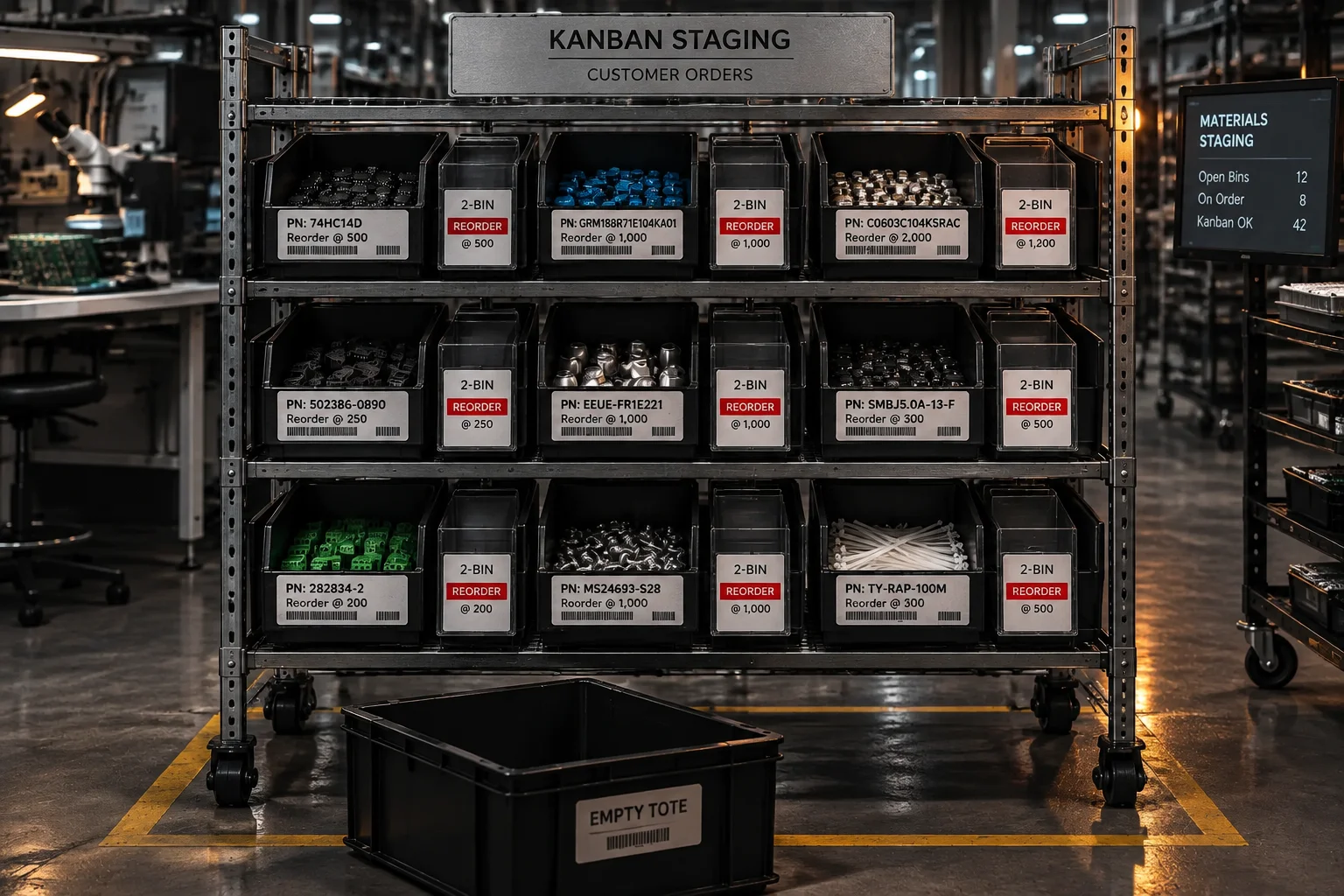
Two-bin kanban at the point of use

The emptiest, cheapest programme to run once the loop size is right. Each bin covers roughly two weeks of consumption, the empty bin is the order, and replenishment is released inside 48 hours of the signal rather than on a forecast.

Trigger
Empty bin or scanned bin card at the point of use
Holding cost
Ours, inside the agreed loop size
Stock owner
GENESIS CIRCUITS until the signal fires

FP-02 / VMI

Vendor-managed inventory

We hold the buffer and read the level, using your usage report rather than your purchase orders. Minimum and maximum levels are set from 13 weeks of actual consumption and reviewed quarterly against the forecast.

Trigger
Weekly min-max review against reported consumption
Holding cost
Ours up to the agreed maximum level
Stock owner
GENESIS CIRCUITS, on our floor or in a bonded store

FP-03 / Consignment

Consignment stock at your site

Stock sits in your building and is invoiced only when it is drawn, which removes your inventory from the balance sheet entirely. The trade is a longer commitment on the quantity we hold and an agreed slow-moving exit.

Trigger
Draw-down from the consignment location, reported at consumption
Holding cost
Ours until the part is drawn and invoiced
Stock owner
GENESIS CIRCUITS, invoiced on consumption

FP-04 / Call-off

Scheduled call-off against a forecast

A six-month rolling forecast with a four-week frozen window, called off weekly. Material inside the frozen window is committed, so the price is stable and the lead time is short, at the cost of owning the material earlier.

Trigger
Firm call-off inside the frozen window
Holding cost
Yours from the freeze date, ours before it
Stock owner
You after the freeze, GENESIS CIRCUITS before

FP-05 / Build to order

Build to order

Material is bought against a released order, so nothing is held and nothing is at risk except work in progress. It is the right model for a low-volume, long-tail or high-value programme where the carrying cost is smaller than the write-off risk.

Trigger
Released purchase order with a frozen BOM revision
Holding cost
None; material is bought against the order
Stock owner
GENESIS CIRCUITS as work in progress only

FP-06 / Turnkey

Turnkey with a rolling forecast

We own the BOM, buy the long-lead parts against the forecast and ship finished assemblies. The 3-6 week production lead time after material release is gated by component availability, not by line time, which is why long-lead parts are bought on forecast under this model.

Trigger
Rolling forecast plus a release against the agreed pull signal
Holding cost
Ours on long-lead and bonded parts, priced into the unit
Stock owner
Mixed: we own the kit, you own the finished goods
Despatch bench with labelled cartons, an ESD tote and a packing list being checked against a pallet label

How fulfilment is run

Loop size, stock ownership and the landed number

Sizing a kanban loop from consumption, not from hope

A bin size is set from the weekly consumption rate multiplied by the replenishment lead time plus a safety allowance, and then rounded up to a packaging multiple. On a 3-6 week production lead time that arithmetic normally lands on a two-week bin and a two-bin loop, which holds four weeks of cover in total. If the calculated loop exceeds eight weeks of consumption the model is wrong for that part, and the honest answer is a scheduled call-off or a bonded-store position instead of a kanban that will empty out.

Which side of the balance sheet carries the stock

Consignment and VMI move inventory off your books while we carry it, which is worth real money in the quarters where your cash is funding a ramp. The trade is commitment: consignment needs a defined minimum draw and an agreed exit for slow-moving stock, and VMI needs a usage feed we can trust rather than a monthly summary. Build-to-order carries no holding cost at all and is the model most first programmes should start on, because nothing is bought until the revision is frozen.

Incoterms and the number that actually matters

FOB Penang is the default quote because it separates the freight decision from the manufacturing decision. DDP is quoted whenever a buyer wants one landed number per unit, and that is increasingly the request now that the 800 US dollar de-minimis exemption has ended and every shipment attracts duty and an entry. Section 301 adds 25% on many China-origin goods, so the Penang and Shenzhen routes are priced side by side and the cheaper route is named in the quote rather than left to assumption.

Order parameters

Order, documentation and shipping parameters

Eleven parameters that decide how an order is placed, frozen, packed and paid for. Where a parameter has an optional position, the optional column is the one to ask about at award rather than after the first shipment.

Order, documentation and shipping parameters per programme
Parameter Standard position Optional position Evidence or note
Minimum release 1 panel on production Zero MOQ on prototypes, so 1 board is an order Stated on every quotation
NRE per order $150-500 covering stencil, programming and profile Waived on a repeat revision that reuses the stencil and program Billed once per revision
Forecast horizon 6 months rolling with a 4-week frozen window 12 months where a part carries a 20-week lead time Frozen window is what triggers material purchase
Change-order window 14 days before material release 7 days on a bonded-stock programme Changes inside the window are quoted as a new release
Buffer stock agreement None by default VMI min-max or a bonded-store bin at the distributor Level reviewed quarterly against reported consumption
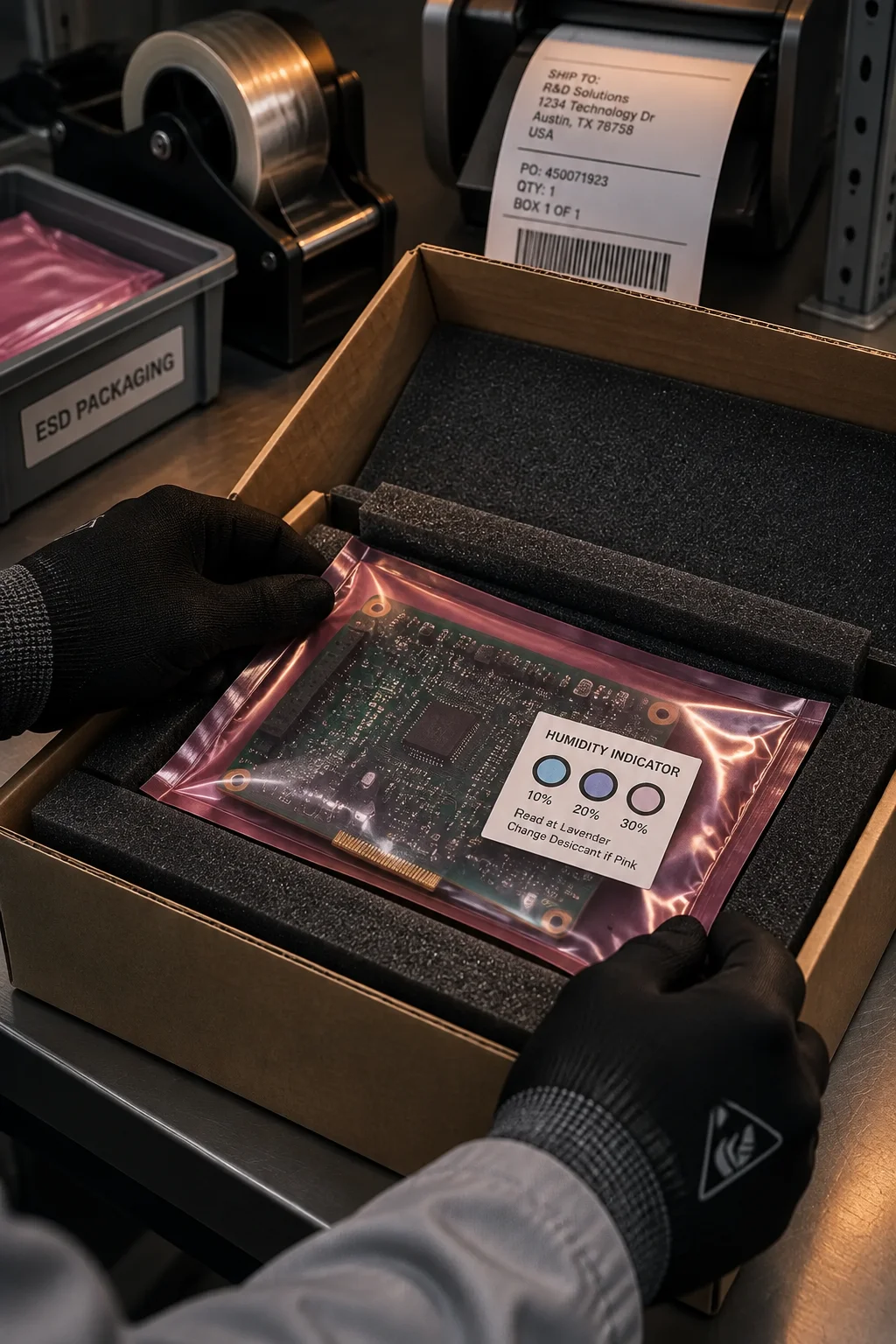
Packaging specification Anti-static bag inside a carton with edge protection Moisture-barrier bag with desiccant and an indicator card ANSI/ESD S20.20 for handling, J-STD-033 for MSL parts
MSL handling record Floor-life clock logged per reel from the day the carrier is opened Bake and re-seal before shipment on MSL 3 and above Bake at 125 C for 24 hours, then re-sealed with desiccant
Incoterms offered FOB Penang as the default quotation basis EXW, CIF, DAP and DDP DDP is the only option where the duty and entry sit with us
Freight mode Express air for prototypes, 3-5 working days door to door Air freight or sea LCL and FCL for production volumes Sea is chosen for boxed builds where transit time is not critical
Documentation per shipment Commercial invoice, packing list, certificate of conformance Panel-linked traceability file, RoHS 3 and REACH declaration, test data Traceability resolves to the serial number, not to the batch
Payment terms 50% on order and 50% on shipment for a new programme Net-30 after three completed orders Terms are restated on every order acknowledgement

Packaging and ESD

Packaging and shipping checklist before a carton is sealed

Eight checks are completed at packing. Each one exists because a board that leaves the building clean and dry can still arrive contaminated, discharged or cracked.

Moisture-barrier bag

Assemblies carrying a moisture-sensitive part go into a barrier bag with desiccant, heat sealed or vacuum sealed. The floor-life clock is reset at the seal, so the recipient starts from a known point rather than from an unknown one.

Humidity indicator card

A card with 10, 20, 30 and 40 percent spots is enclosed and read at packing, and the reading is recorded against the carton. A card that shows a change in transit is the earliest evidence that a bag failed.

Anti-static shielding bag

Boards are bagged to ANSI/ESD S20.20 practice before they leave the ESD-controlled area, with the bag sealed rather than folded. The shielding bag protects against a discharge from the outside, not against one from the board.

Conductive foam and trays

Fine-pitch leads and connectors are supported in conductive foam or in a tray with pockets sized to the package, so a pin cannot take the load of the board above it. Loose boards in a carton are never acceptable.

ESD tote and carton liner

Every board travels inside a conductive tote or an approved liner, and the tote is closed before it leaves the area. The liner is inspected for tears at packing, because a torn liner is electrically the same as no liner.

Carton and edge protection

Double-wall corrugated with corner boards on any air-freight shipment, sized so the contents cannot shift. Void fill is used to stop movement rather than to fill space, and the carton is strapped rather than taped shut.

Sea-freight sealing

A sea container is a humidity chamber for the whole transit, so the barrier bag and desiccant are mandatory rather than optional and the carton is lined. Long sea legs also need the desiccant quantity calculated from the internal volume, not estimated.

Labels and documents

Each carton carries the MSL label, the ESD warning label, the part number, the quantity and the serial list, with the indicator-card reading recorded. The packing list, certificate of conformance and traceability file are attached or sent ahead.

Macro record

A kanban shelf, read the way the line reads it

The empty position is the order. A shelf photographed at the moment of a pull is the clearest evidence that a replenishment signal is physical rather than administrative.

Labelled kanban bins on a shelf with one bin position empty and the card raised beside the remaining stock
Two-bin kanban shelf / one position empty after a pull Replenishment released inside 48 hours of the signal; 98.1% on-time delivery

Buyer questions

Incoterms, humid destinations and the post-de-minimis landed cost

Get Quote Call Us
marker. Behaviour comes from inquiry-handler.js via data attributes — no inline JS, no onclick, no inline style (CSP: script-src 'self'; style-src 'self'). ============================================================================ --> marker. Behaviour comes from inquiry-handler.js via data attributes — no inline JS, no onclick, no inline style (CSP: script-src 'self'; style-src 'self'). ============================================================================ --> marker. Behaviour comes from inquiry-handler.js via data attributes — no inline JS, no onclick, no inline style (CSP: script-src 'self'; style-src 'self'). ============================================================================ -->