Sector / Automotive and electric vehicles
PCBA for Automotive and EV Systems
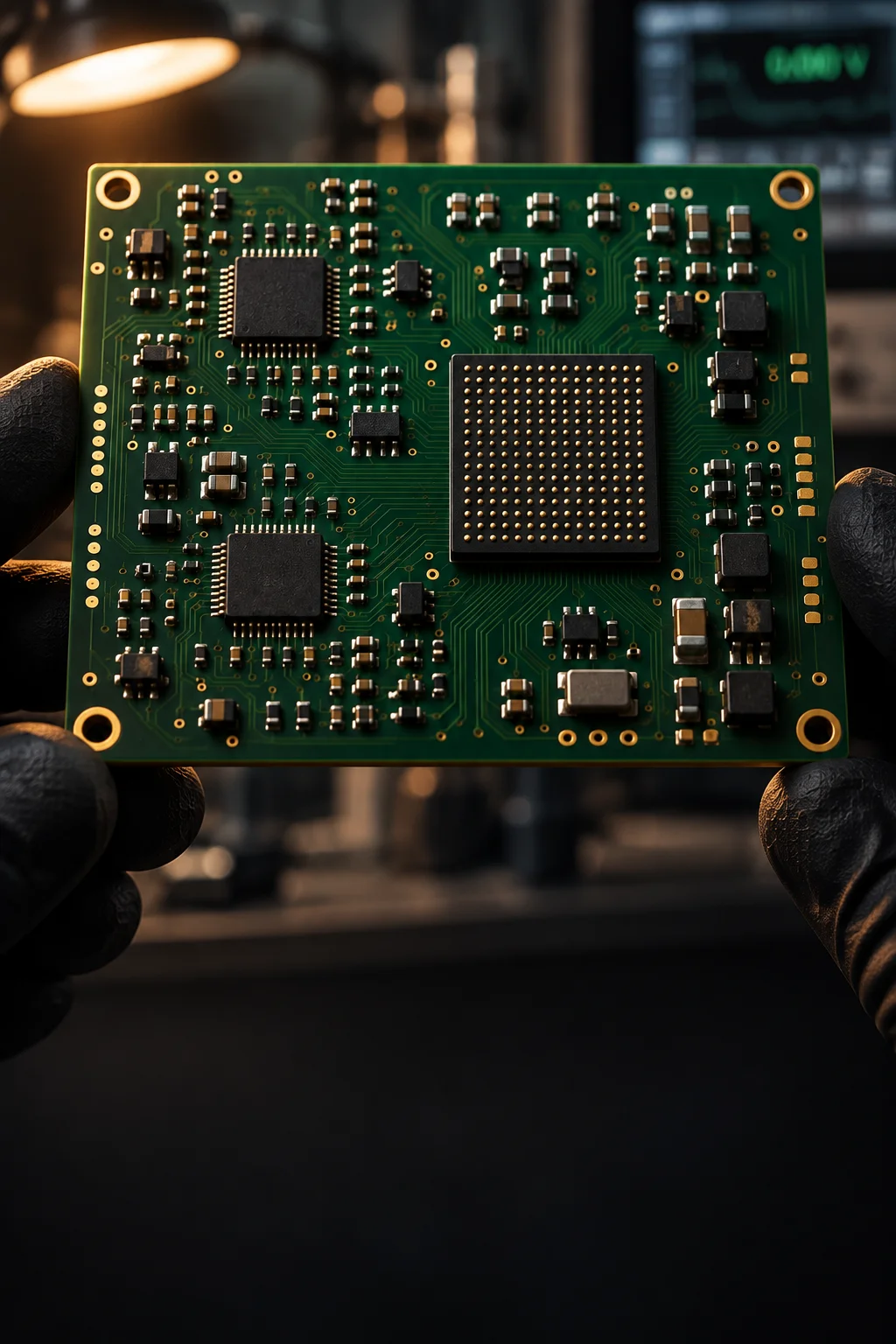
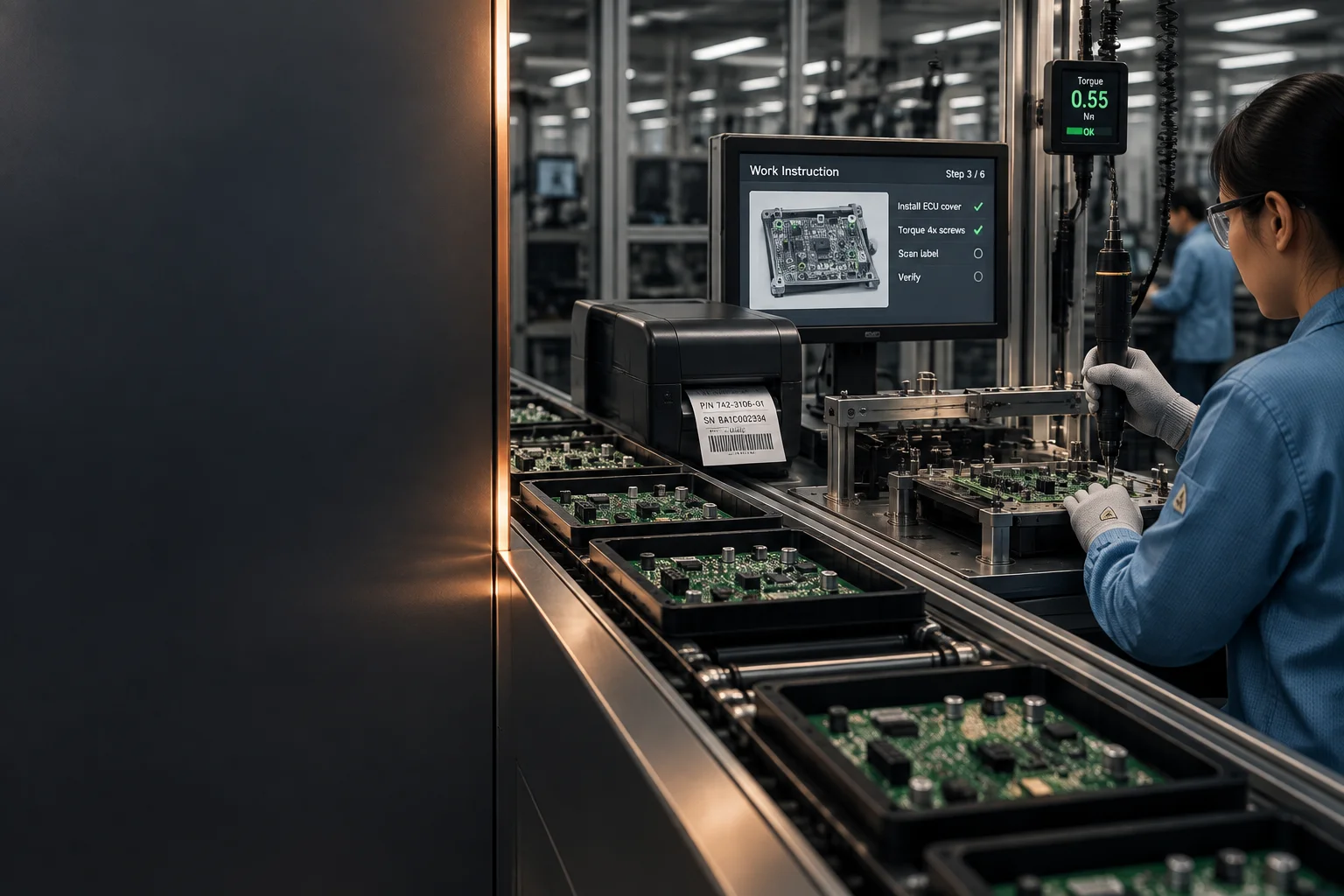
An automotive board is judged by what it does in year twelve, in a vehicle that has already changed hands twice. Commercial-grade parts are not an option, the temperature grade is set by where the module sits rather than by what the silicon can survive, and the paperwork has a retention clock measured in decades.
IATF 16949 requirements audited - AEC-Q100 / Q101 / Q200 sourcing - Grade 0 to +150 C - IST 1000-2000 cycles - PPAP - 15-year record retention
Buyer pain points
Four numbers that decide an automotive programme
Each row pairs an automotive requirement with the cost of discovering it after the part is in a vehicle rather than on a bench.
| Pain point | The number | Consequence if it is left unmanaged |
|---|---|---|
| Component qualification | AEC-Q100 for ICs, AEC-Q101 for discretes, AEC-Q200 for passives. | A commercial-grade part that passes bench validation can fail in the field, and every untested substitution is a potential warranty campaign rather than a scrap cost. |
| Temperature grade | Grade 0 is -40 C to +150 C, Grade 1 is -40 C to +125 C, Grade 2 is -40 C to +105 C, and Grade 3 is -40 C to +85 C. | Specifying Grade 2 where the module sits under-hood buys a cheaper part and moves the failure to the vehicle, where the repair cost is set by the dealership rather than the assembler. |
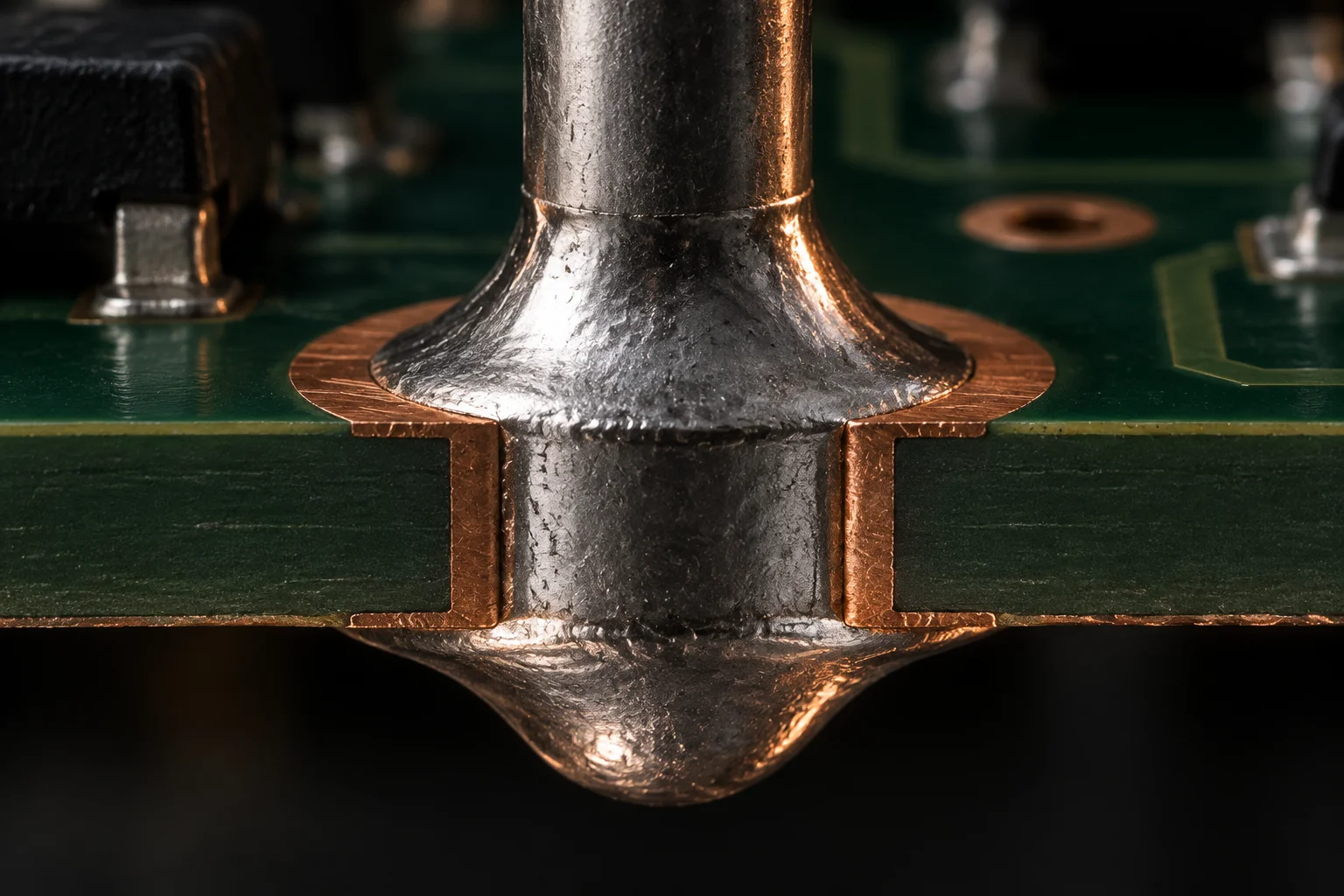
| Interconnect reliability | Interconnect stress testing from -40 C to +125 C for 1000-2000 cycles. | Via-barrel cracking from Z-axis expansion does not appear in a functional test and does not reproduce on the bench, so it reaches the field as an intermittent no-fault-found return. |
| Traceability and retention | A laser-marked 2D serial on every board with 15-year record retention. | Without per-unit traceability, a supplier notice covering one date code forces quarantine of an entire production year instead of the affected serials. |
programme      AUTO-5120 - 8-layer high-Tg FR-4, 2 oz outer, thermal vias
application    under-hood power module, EV auxiliary drive
temp grade     AEC-Q100 Grade 0, -40 C to +150 C
ist cycling    PASS  1500 cycles, -40 C to +125 C, no barrel crack
solder float   PASS  288 C for 10 s, every lot, no delamination
caf           PASS  750 h at 85 C / 85% RH, 100 VDC bias, no failure
cleanliness    0.58 ug NaCl/cm2, customer limit is 0.75 ug
ppap level    Level 3 submission, PSW signed
serialization laser 2D Data Matrix, unique per board
retention     15 years, indexed by serial number
psw status    approved - interim approval not required
How the build is run
Qualified for the vehicle, documented for the auditor
Temperature grade drives every part choice
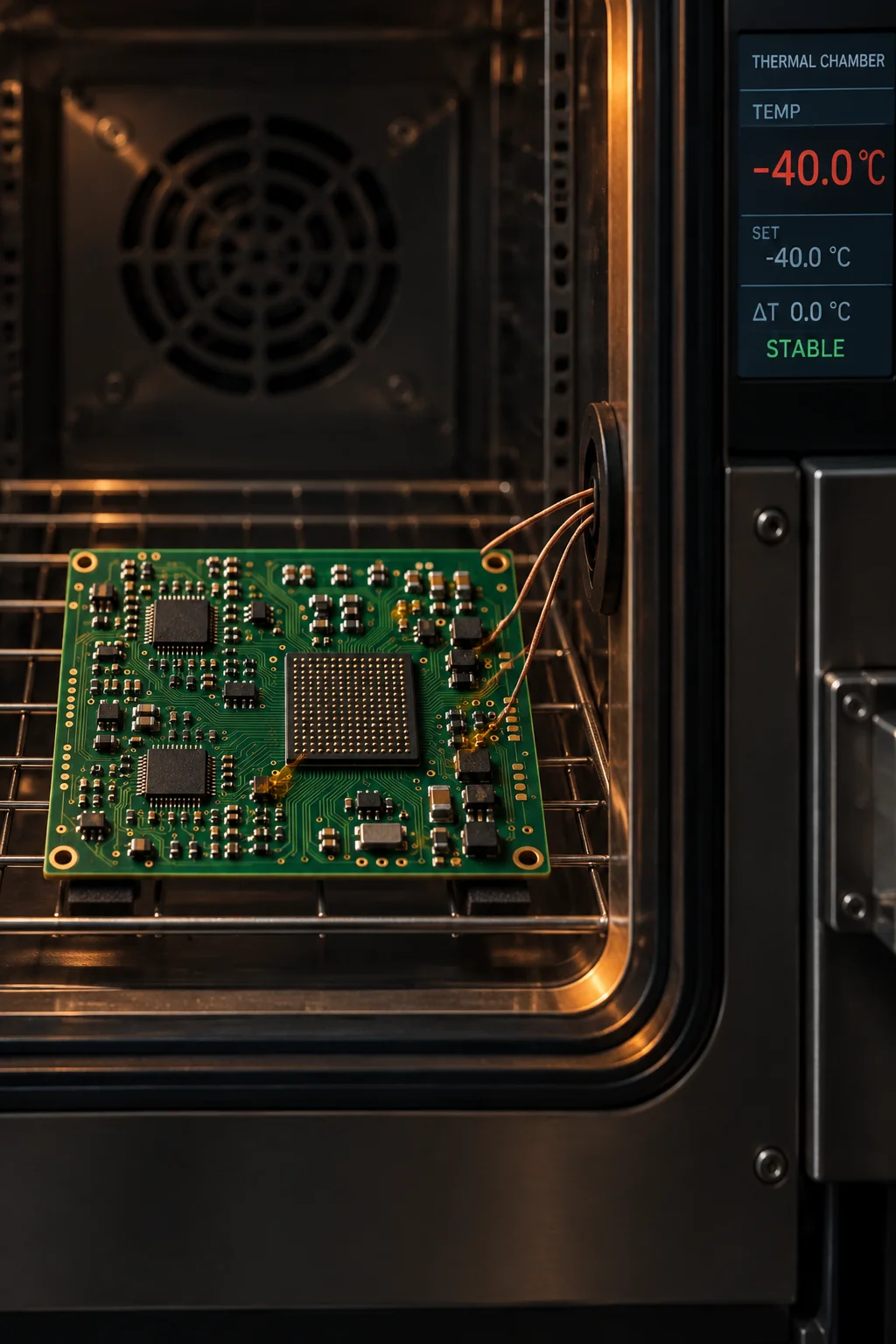
The grade is fixed by where the module physically sits, not by what the silicon data sheet allows. Under-hood and near-engine electronics run Grade 0 from -40 C to +150 C, which means AEC-Q100 qualified ICs, AEC-Q101 discretes, AEC-Q200 passives, high-Tg laminate above 170 C to control Z-axis expansion, and 25 um minimum via plating. A Grade 2 part in a Grade 0 location saves cents at the bill of materials and moves the failure into a vehicle, where the repair is priced by a dealership network rather than by an assembler. We treat mixed grades on one assembly as a documentation defect, because the record has to show which grade applies to which reference designator.
Power stages, heavy copper, and thermal vias
EV and hybrid programmes add 2 oz or heavier copper for battery-management and motor-drive stages, thermal via arrays under the power devices, and solder-layer void control that a visual inspection cannot assess. X-Ray void measurement on the power-module solder layer is the acceptance gate, because a voided joint looks acceptable from above and becomes a thermal hot spot at current. High-current connectors and press-fit terminals are placed and verified separately from the SMT pass, and selective soldering carries the through-hole power joints without disturbing the fine-pitch logic on the reverse side.
Records that stay retrievable for fifteen years
Every board is laser-marked with a unique 2D Data Matrix linking it to the panel, the material lots, the reflow profile, the AOI and X-Ray results, and the operator. The record is indexed by serial number rather than by shipment, which is the difference between answering a field question about 300 units and quarantining a year of production. Storage format is chosen so retrieval does not depend on a single application version, and an annual retrieval test is logged to keep the retention claim verifiable.
Requirements to capability
Automotive requirement to capability mapping
Every row is a clause an automotive quality engineer or a customer-specific requirement will ask to see evidence for.
| Requirement | Governing standard | What we do | Evidence |
|---|---|---|---|
| Quality management system | IATF 16949 | Audited against IATF 16949 requirements with APQP, PFMEA, control plan, MSA, and SPC discipline applied from the NPI stage rather than retrofitted before an audit. | Audit reports and control plan per part number |
| Component qualification | AEC-Q100, AEC-Q101, AEC-Q200 | Authorized-distribution sourcing restricted to AEC-Q qualified parts, with the qualification grade recorded against each reference designator on the bill of materials. | Material certificates and grade mapping |
| Temperature grade capability | AEC-Q100 grades 0 to 3 | Grade 0 build from -40 C to +150 C for under-hood and near-engine modules, with high-Tg laminate above 170 C and low Z-axis CTE to protect the plated barrel. | Design record naming the grade per assembly |
| Via and interconnect reliability | IPC-6012DA, IPC-9701 | Interconnect stress testing from -40 C to +125 C for 1000-2000 cycles, with 25 um minimum via plating and cross-sections at 2 minimum per lot. | IST report and cross-section images |
| High-current power stages | IPC-6012DA, IPC-2221 | 2 oz and heavier copper for battery-management and motor-drive stages, thermal via arrays, and X-Ray void measurement on the power-module solder layer. | Copper coupon and void measurement report |
| Thermal shock resistance | JESD22-A106, IPC-TM-650 2.6.8 | Solder float at 288 C for 10 seconds minimum on every lot to expose delamination and measling before the assembly is committed to production. | Solder float record per lot |
| Electrochemical migration resistance | IPC-TM-650 2.6.25 | CAF testing for 500-1000 hours at 85 C and 85% RH under 50-100 VDC bias with no failures allowed, plus ionic contamination below 1.56 ug NaCl per square centimetre and below 0.75 ug where the customer demands it. | CAF and ionic contamination certificates |
| Workmanship and inspection | IPC-A-610 Class 2 and Class 3, IPC-7095 | Class 2 baseline with Class 3 inspection on safety-related sections, 100% AOI on all SMT builds, and X-Ray on every BGA and QFN with voids held under 25% at Class 2 and 10% at Class 3. | AOI and X-Ray records per serial |
| Traceability marking | IPC-1782, IATF 16949 clause 8.5.6.1 | Laser-marked unique 2D Data Matrix on every board, linked to the panel ID, material lots, process parameters, and test results. | Traceability data file indexed by serial |
| Production-part approval | PPAP, APQP | PPAP packages issued at the submission level agreed per programme, including PFMEA, control plan, dimensional results, material and performance test results, initial process studies, and the part submission warrant. | Signed PSW and PPAP file |
| Safety-related development | ISO 26262 awareness | Documented process records, change control, and serialized test evidence on ADAS and safety-related assemblies so an ASIL argument can cite the build history. | Process record package for the safety case |
| Record retention | IATF 16949 clause 7.5.3.2.1 | 15-year retention keyed to the serial number rather than the shipment, in a format that does not depend on one application version, with an annual retrieval test logged. | Retention register and retrieval test record |
| Environmental compliance | RoHS 3, REACH SVHC, ELV | RoHS 3 across 10 restricted substances, REACH SVHC screening, and end-of-life-vehicle material declarations carried on the bill of materials. | Declaration of conformity per shipment |
PPAP and traceability
What closes out a production-part approval
The blocks below are the elements a customer quality engineer signs against before the part number is released to volume.
Submission level is a commercial decision
PPAP submission levels 1 through 5 differ by several multiples of engineering hours, and the level belongs in the quotation rather than in the kick-off meeting. We agree the level per programme at award, state the engineering effort it carries, and hold the file open for the customer's own witness testing where the programme requires it. A Level 3 submission with a signed part submission warrant is the default for a new part number on an existing customer; a Level 5 submission with a full run-at-rate is agreed only where the customer's own procedures demand it.
Interim approval is a real risk rather than a formality. Where a dimensional or material result sits outside the drawing but inside the functional requirement, we raise the deviation before submission, with the containment plan attached, so the customer approves a known condition rather than discovering it at a supplier audit.
design records       issued  Gerber, stackup, assembly drawing rev C
change documents      issued  ECN-0442 laminate Tg change, customer approved
process flow          issued  14 operations, 3 special characteristics
pfmea                issued  RPN above 100 reduced to 3 actions
control plan          issued  reflow, AOI, X-Ray, hipot, laser mark
dimensional results   PASS    12 of 12 characteristics in tolerance
material results      PASS    laminate, solder alloy, coating lots named
performance results   PASS    IST, solder float, CAF, ionic contamination
initial process study Cpk 1.42 on placement accuracy, target 1.33
msa                 issued  gauge R&R at 8.6% of tolerance
lab documentation    issued  qualified laboratory scope on file
sample parts         issued  300 units, master sample retained
psw                 approved level 3, no interim approval required
Programme record
An EV auxiliary drive module through a full PPAP
The four elements: sector, requirement, what we did, and the result with numbers.
Record
- Sector
- Electric vehicle power electronics
- Programme
- AUTO-5120
- Volume
- 26,000 units per year
- Class
- IPC-A-610 Class 3 on the power section
Requirement
An 8-layer under-hood power module with a 2 oz power stage, Grade 0 operation from -40 C to +150 C, a Level 3 PPAP submission, and a laser-marked serial per board retained for 15 years. The outgoing supplier had been building the same design with mixed component grades and no grade mapping against reference designators.
What we did
Rebuilt the bill of materials with AEC-Q100, Q101, and Q200 parts mapped per reference designator, moved the stackup to high-Tg laminate above 170 C with 25 um minimum via plating, and added thermal via arrays under the power devices. Ran a full PPAP with PFMEA and control plan, added X-Ray void measurement on the power-module solder layer, and indexed the traceability record by serial rather than by shipment.
Result
Interconnect stress testing completed 1500 cycles from -40 C to +125 C with no barrel crack at cross-section. Solder float at 288 C for 10 seconds passed on every lot with no delamination. CAF testing ran 750 hours at 85 C and 85% RH under 100 VDC bias with no failure, and ionic contamination measured 0.58 ug NaCl per square centimetre against a customer limit of 0.75 ug. Placement accuracy held a Cpk of 1.42 against a 1.33 target. The Level 3 part submission warrant was approved on first submission with no interim approval, and the first four production lots shipped at 98.1% on-time delivery with zero field returns over the following twelve months.
Buyer questions
PPAP, qualification premium, and record retention
We issue the PPAP package with design records, approved change documents, process flow, PFMEA, control plan, dimensional results, material and performance test results, initial process studies, measurement-system analysis, qualified laboratory documentation, sample parts, a master sample, checking aids, and a part submission warrant. Submission level is agreed per programme rather than assumed, because Level 3 and Level 5 differ by a factor of several in engineering hours.
Automotive construction typically costs 30-100% more than consumer-grade assembly, spent on AEC-Q qualified components, high-Tg laminate, 25 um minimum via plating, 2 oz copper on power stages, laser serialization, and the validation and record-retention burden. The comparison that matters is a warranty campaign: a single recall covering 20,000 vehicles costs far more than the qualification premium across the whole production volume.
Every board carries a laser-marked 2D Data Matrix linked to the panel, the material lots, the reflow profile, the AOI and X-Ray results, and the operator. The record is indexed by serial number rather than by order, stored in a format that does not depend on a single application, and a retrieval test is logged annually so the fifteen-year retention claim is verifiable rather than aspirational.