NPI / prototype, pilot and volume
From Prototype to Production Without Re-Qualification
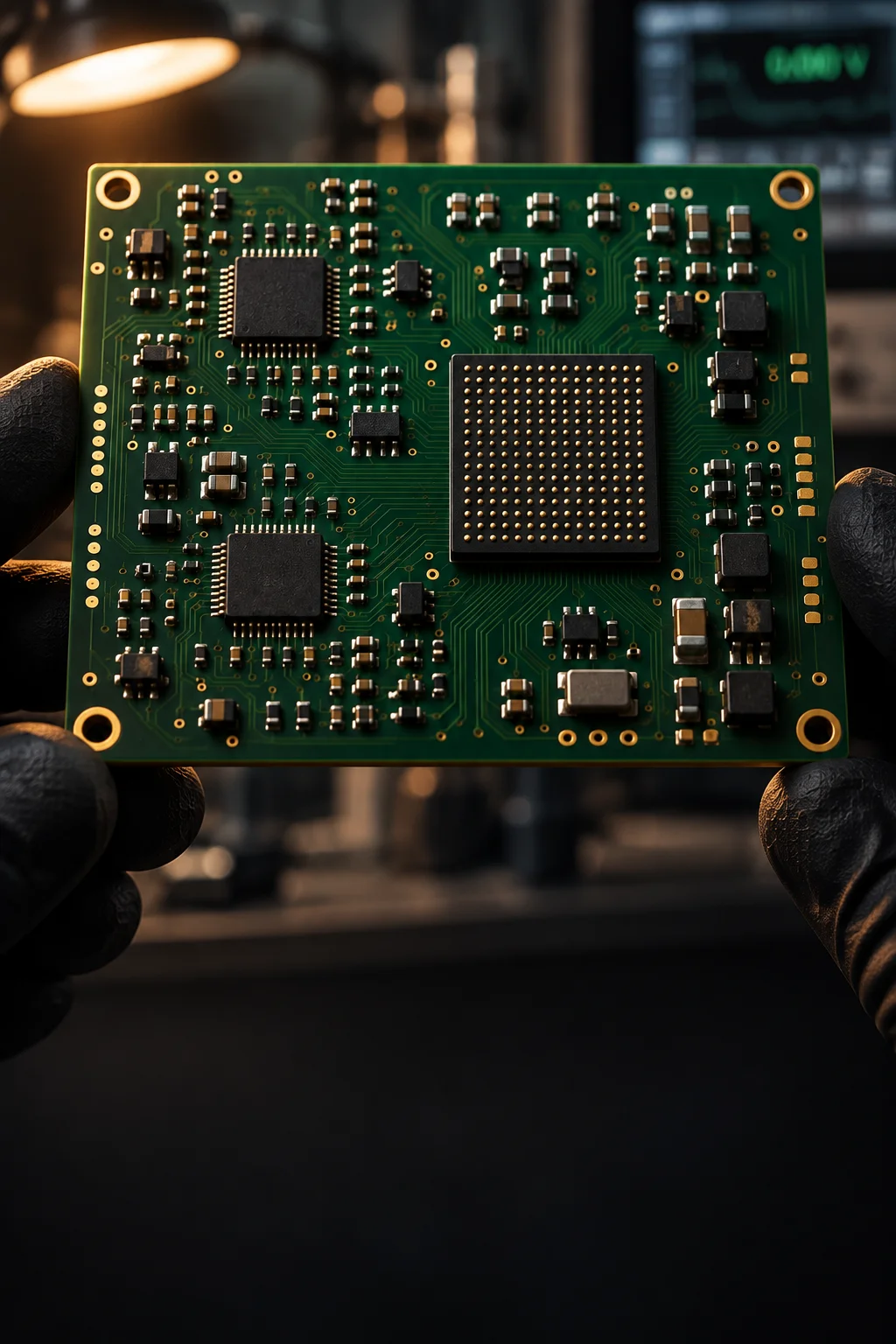
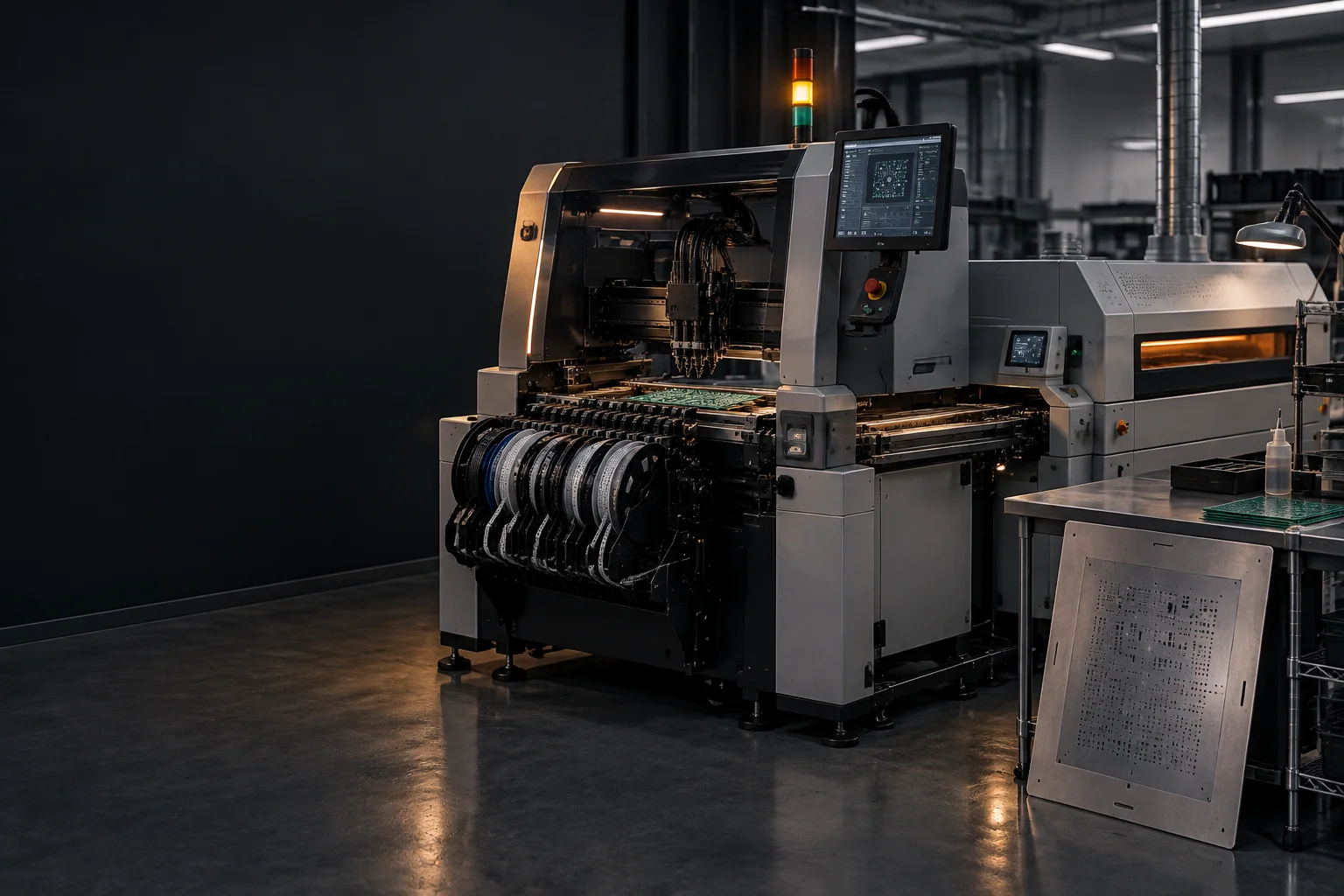
A prototype built on the line that will eventually run volume is a smaller version of the same process, not a different one. Same stencil revision, same placement programme, same inspection class. That is what removes the second qualification round when the programme moves from 5 boards to 5,000.
NPI process
Six stages from data package to volume release
Each stage ends with a written deliverable. A programme does not advance because a date arrived; it advances because the deliverable was accepted.
Data package and DFM
Gerbers, BOM, assembly drawing and target quantity are checked within one working day. The CAM report names pad, aperture and panel issues with the change each one needs.
Prototype build
1-5 assemblies in 3-5 working days for a simple 2-layer board and 5-10 for a complex one, on a real stencil rather than a hand-applied paste, so the result predicts the volume build.
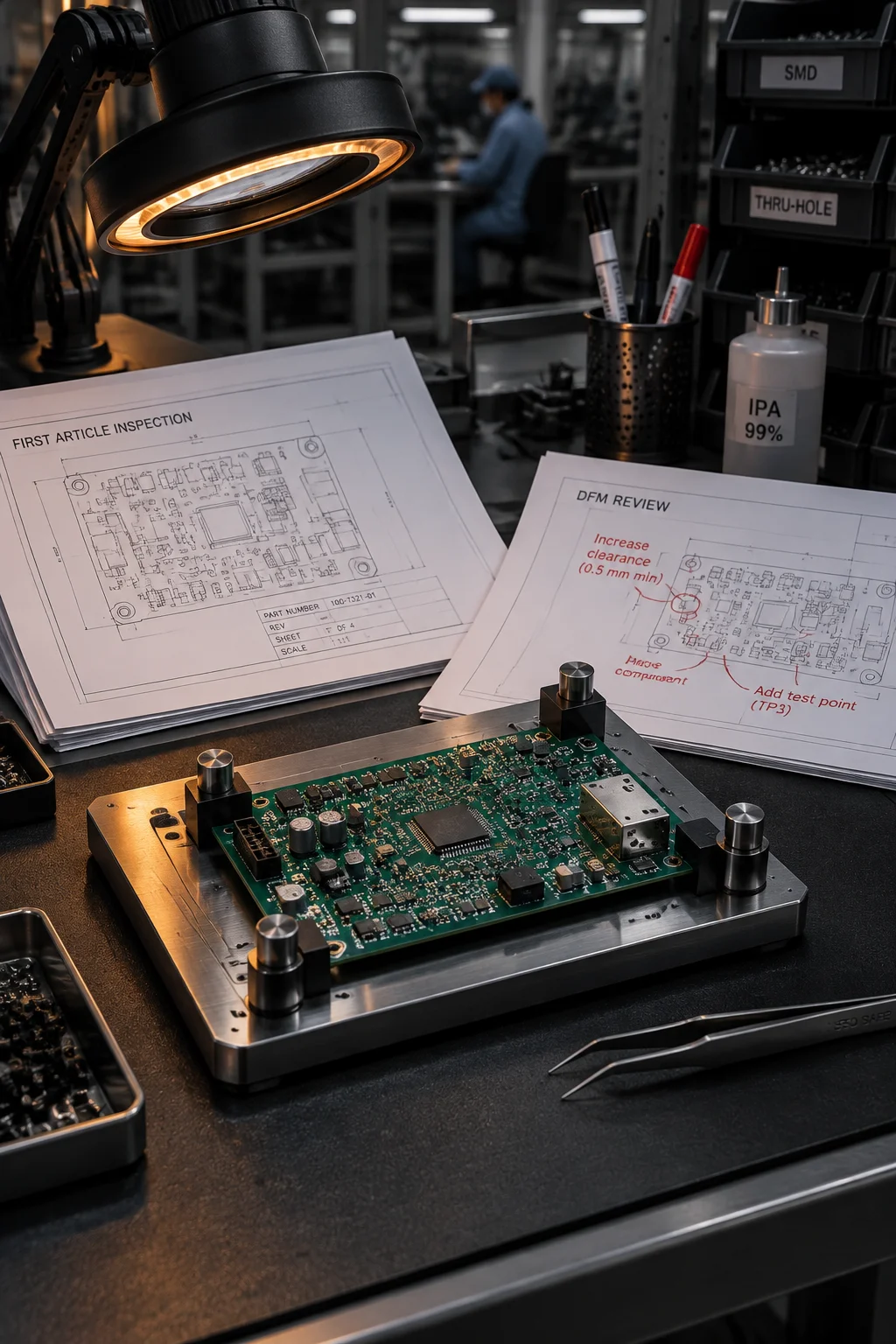
First article inspection
Dimensional check, AOI report, X-Ray void measurement on every BGA and a functional test log. The first article is the document you sign off on for volume.
Design freeze and tooling
The revision is frozen and production tooling is ordered: a framed stencil at $80-200, and an ICT fixture only where the volume band justifies its $2,000-50,000 cost and 4-8 week lead time.
Pilot run
25-250 units run with SPC on placement and profile, and a process capability study on the critical dimensions. This is where the volume yield is proven, not assumed.
Volume release
Production releases from 1 panel against the frozen revision, with 3-6 weeks quoted after material release and a traceability record that follows each shipment.
Volume bands
What changes as the quantity moves
Ten bands, from a single prototype to 50,000 units. Tooling and test strategy are the two columns where money is decided.
| Volume band | Quantity per release | Lead time | Tooling position | Test strategy |
|---|---|---|---|---|
| Prototype, quick-turn | 1-5 pcs | 3-5 working days | Frameless stencil $30-60 | AOI plus flying probe |
| Prototype, complex | 6-25 pcs | 5-10 working days | Frameless stencil | AOI, X-Ray and FCT |
| Pilot run | 26-100 pcs | 2-3 weeks | Framed stencil $80-200 | Flying probe plus FCT |
| Low volume | 101-250 pcs | 3-4 weeks | Production stencil | Flying probe plus FCT |
| Low-mid volume | 251-500 pcs | 3-4 weeks | ICT fixture decision point | ICT plus FCT where fixture NRE is justified |
| Mid volume | 501-1,000 pcs | 4-5 weeks | Fixture amortised | ICT plus FCT |
| Mid volume | 1,001-2,500 pcs | 4-6 weeks | Fixture amortised | ICT plus FCT |
| Mid-high volume | 2,501-5,000 pcs | 5-6 weeks | Spare stencil and fixtures held | ICT plus FCT, AOI on 100% |
| High volume | 5,001-10,000 pcs | 6 weeks | Capacity booked per quarter | AOI, ICT and FCT |
| High volume | 10,001-50,000 pcs | 6 weeks and up | Dedicated line window | AOI, ICT and FCT with SPC reporting |
Scaling
What stays the same, and what is allowed to change
A programme that has to be re-qualified between prototype and volume pays twice for engineering. This is how that is avoided.
Fixed across every band
The stencil revision, the placement programme, the reflow profile library entry and the inspection class stay fixed from the first prototype onward. AOI coverage is 100% of SMT builds whether the run is 5 boards or 50,000.
Scale with the band
Panelisation, kitting method and test strategy move with quantity. Flying probe at 1-100 units carries no fixture NRE at roughly $3-10 per board, while an ICT fixture at $2,000-50,000 only earns its place once the volume band can amortise it.
The cost curve you are buying into
On a 200-placement board excluding the bill of materials, industry-typical pricing runs $40-80 at 1-5 pieces, $8-15 at 100 and $3-7 at 1,000 and above. Placement cost falls from prototype rates to $0.005-0.015 per passive.
Engineering time that is charged once
NRE of $150-500 per order covers stencil, programming and profile development for a revision. A revision change is the only trigger for a new NRE; running the same revision at a higher quantity is not.
NPI gate log
The acceptance limits a pilot has to clear
Pulled from a pilot gate review. A programme leaves pilot only when every line reads pass, and any line held is closed with a corrective action before volume is scheduled.
FAI-01  first article n=3       dimensional, AOI, polarity      ACCEPT
FAI-02  BGA void, Class 3       limit 10%      measured 4.2%   ACCEPT
FAI-03  ionic cleanliness       limit 0.78 ug/cm2   measured 0.41 ACCEPT
FAI-04  placement Cpk           target 1.33    measured 1.61   ACCEPT
FAI-05  functional test         limits 12 rails, 120 units, 0 fail ACCEPT
FAI-06  first-pass yield        target 98%     measured 99.2%  ACCEPT
HOLD-01 0402 tombstone on J7    3 units        stencil aperture revised
        corrective action closed, re-run 25 units, 0 repeat
released to volume  band 501-1000  stencil rev C  profile P-11
Macro record
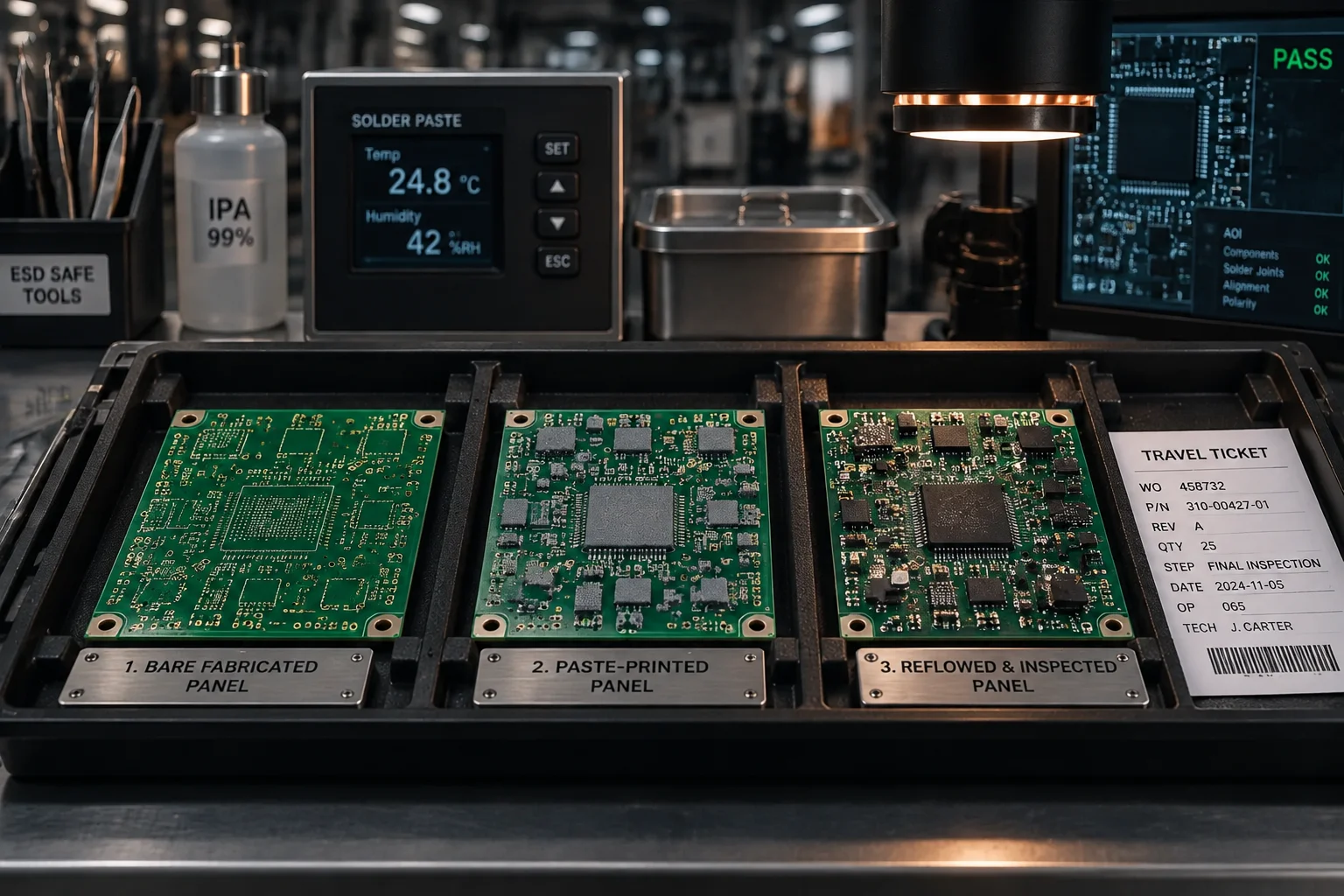
From a tray of first articles to a production magazine
Questions
Scaling questions from hardware teams
No. The prototype, the pilot and the volume release run on the same lines with the same stencil revision and the same placement programme, so the first article approved at NPI stands for volume. Only the panelisation and the test strategy change with the band.
One panel. Prototypes carry zero MOQ, production releases from 1 panel, and a programme can sit in the 26-100 unit band for months without a minimum annual commitment attached to it.
On a 200-placement board excluding the bill of materials, industry-typical pricing runs $40-80 at 1-5 pieces and falls to $3-7 at 1,000 and above. Placement price drives the curve: $0.005-0.015 per passive at volume, against prototype rates three to five times higher.